Is Gambling the Worst Addiction?
Gambling is not the worst addiction by every measure, but it is the hardest addiction to detect and among the hardest to stop. Substance addictions kill more people directly. Gambling destroys finances and relationships faster, and usually before anyone notices.
Among New Jersey adults who gambled in the past year, 9.1 percent screen as high-risk problem gamblers, per the 2023 Rutgers Center for Gambling Studies report. That is close to one in eleven.
Which addiction is worst depends entirely on which harm gets measured. Five dimensions separate them, and gambling ranks differently on each one.
Key Takeaways
- More Americans meet criteria for Gambling Disorder (1.9 percent) than for cannabis (1.6 percent), opioid (0.71 percent), methamphetamine (0.21 percent), or cocaine (0.34 percent) use disorder.
- Roughly 71 percent of people with a gambling problem never seek treatment, per Suurvali and colleagues, the widest treatment gap of any addictive disorder.
- Psychiatry classifies gambling and substance addiction as the same family of disorders, a change made in 2013 on the strength of shared neurobiology and treatment response.
- Evidence on suicide risk is contested. The American Psychiatric Association reports the highest risk of any addictive disorder, while national registry data ranks it below substance use disorders.
Did you know most health insurance plans cover substance use disorder treatment? Check your coverage online now.
What Makes One Addiction Worse Than Another?
Five dimensions determine how severe an addiction is: direct mortality risk, speed of financial harm, how easily it is concealed, how hard it is to stop and stay stopped, and how much co-occurring illness it carries.
No single addiction ranks worst on all five. Alcohol use disorder produces a withdrawal syndrome that kills without medical supervision. Gambling Disorder produces no physical withdrawal, yet it empties a retirement account in a weekend.
Prevalence complicates the ranking further. More Americans meet criteria for Gambling Disorder than for cannabis, opioid, methamphetamine, or cocaine use disorder, yet gambling receives a fraction of the public health attention.
Ranking addictions on one dimension and calling that the whole answer is the error most coverage makes. Headlines that name a single worst addiction almost always measure overdose deaths alone.
Clinicians assessing gambling addiction weigh all five dimensions together, because a person can be financially ruined without ever being physically ill. The comparison below scores both categories across each one.
Gambling Addiction vs Substance Addiction: A Direct Comparison
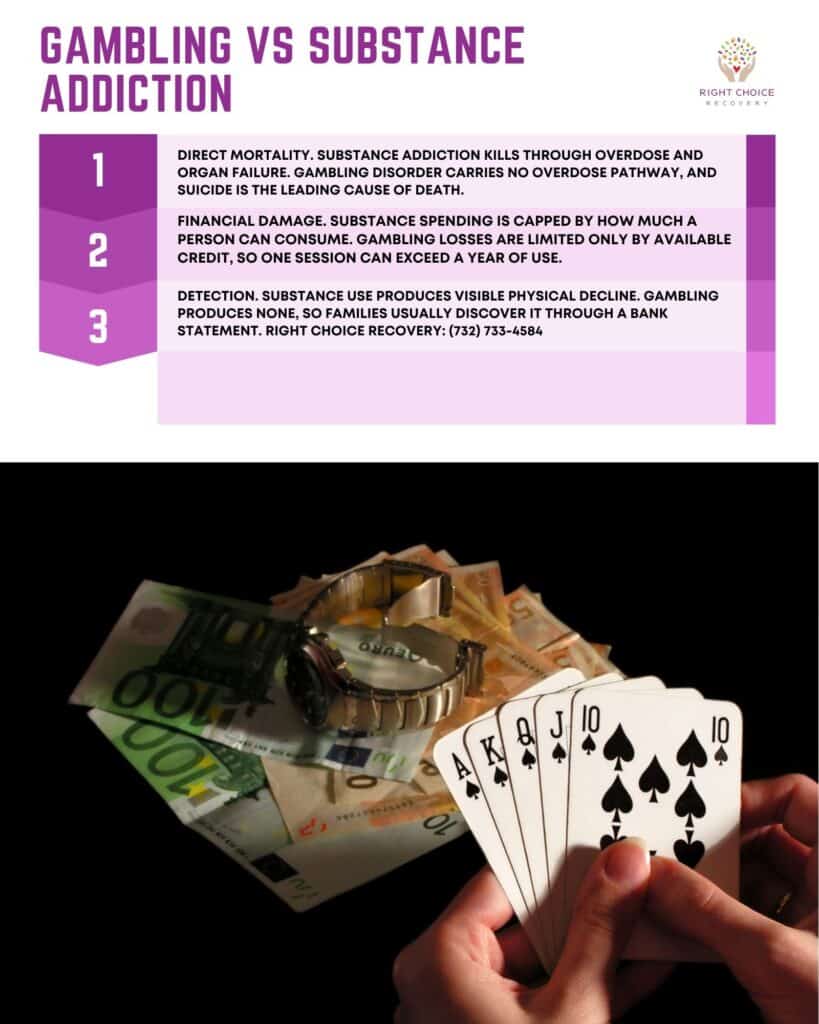
Gambling Disorder and substance use disorder share reward circuitry, tolerance, craving, and relapse patterns, which is why the DSM-5-TR places them in the same chapter. They diverge sharply on how the harm arrives.
The table below compares both across the five dimensions, with a verdict on each. Read it as a map of trade-offs rather than a scoreboard.
| Dimension | Gambling Disorder | Substance Use Disorder | Worse |
|---|---|---|---|
| Direct mortality risk | No overdose pathway | Overdose kills tens of thousands annually | Substance |
| Physical withdrawal danger | Restlessness and irritability | Alcohol and benzodiazepine withdrawal can be fatal | Substance |
| Speed of financial damage | Unbounded; losses limited only by available credit | Capped by how much a person can consume | Gambling |
| Visibility to family | No physical signs at all | Odor, intoxication, physical decline | Gambling |
| Treatment-seeking rate | Around 29 percent ever seek help | Low, but consistently higher than gambling | Gambling |
| Comorbidity burden | 96 percent meet criteria for another lifetime disorder | High, though generally below gambling | Gambling |
| Access and legality | Legal, promoted, available on every phone | Mostly illegal or age-restricted | Gambling |
Substance addictions are more physically lethal. Gambling Disorder is more financially and socially destructive, and it does that damage invisibly. Both hijack the same reward pathways, which is why behavioral addiction now sits beside substance addiction in the diagnostic manual.
That reclassification happened in 2013. Petry and colleagues set out the rationale in the Journal of Gambling Studies: shared neurobiology, overlapping genetic liability, comparable course, and response to the same treatments.
The change also removed the illegal-acts criterion and lowered the diagnostic threshold from five symptoms to four. Gambling Disorder remains the only behavioral addiction the manual recognises in its main text.
Why Is Gambling So Hard to Detect?
Gambling Disorder produces no physical evidence, which delays detection by months or years compared with substance addiction.
The Hidden Addiction
Clinicians and the Council on Compulsive Gambling of New Jersey both call gambling the hidden addiction. A person with alcohol use disorder smells of alcohol, slurs speech, and loses coordination.
A person with Gambling Disorder shows none of that. They sit at a kitchen table on a phone, and the behavior looks identical to checking email.
Opioid and stimulant use produce visible physical decline within months. Gambling produces none, so the condition progresses through its full course while the person appears entirely well.
Why Families Find Out Late
Discovery is almost always financial rather than behavioral. A declined card, a second mortgage, a drained savings account, or a call from a creditor reveals the problem.
Concealment is also easier to sustain. A person hiding gambling hides account balances and screen time, not physical symptoms, and those are simple things to keep private inside a household.
By that point the debt has usually compounded for a year or more. Families describe finding out too late as the defining feature of this condition.
That delay compounds every other harm. A year of untreated gambling adds debt, deepens concealment, and strains the relationships a person needs for recovery.
Late discovery is the strongest argument for calling gambling the worst addiction to live alongside, and it is the dimension where the gap against substance addiction is widest.
Contact us today to schedule an initial assessment or to learn more about our services. Whether you are seeking intensive outpatient care or simply need guidance on your mental health journey, we are here to help.
Is Gambling the Hardest Addiction to Quit?
Gambling ranks among the hardest addictions to quit because the trigger cannot be removed from a person’s life. Recovery from alcohol use disorder allows a person to avoid bars. Nobody avoids money.
What the Relapse Evidence Shows
Relapse rates across addictive disorders have not been measured in a way that permits a clean ranking. Studies use different follow-up windows, different definitions of relapse, and different populations.
What the evidence does establish is that Gambling Disorder carries tolerance, craving, and repeated failed attempts to stop, the same features that define substance addiction.
Anyone claiming a precise relapse ranking across addictions is extrapolating beyond the data. Treat single-number comparisons on this point with caution.
Why Money Makes Relapse Different
Money is a universal cue. A paycheck, a tax refund, or a birthday gift each function as a relapse trigger, and none can be eliminated.
Substance recovery permits environmental control. A person can change routes home, leave a social circle, or remove alcohol from a house. Gambling recovery permits none of those moves, because the cue is the thing a person uses to buy groceries.
Betting apps compound this by placing a casino on a device the person needs for work. Unpredictable payout schedules and distorted beliefs about chance drive that pull, the central concerns of gambling psychology.
Does Gambling Carry the Highest Suicide Risk of Any Addiction?
The evidence here is contested, and most coverage reports only one side of it.
The American Psychiatric Association states that Gambling Disorder carries the highest suicide risk of any substance use or addictive disorder. The APA reports that roughly one in two people with gambling problems experience suicidal thoughts and one in five attempt suicide.
A 2024 comparative cohort study in The Lancet Regional Health, Europe complicates that picture. Using Norwegian national health registry data, researchers found suicide was the leading cause of death among patients with Gambling Disorder, accounting for 25 percent of deaths.
Suicide risk ran 5.12 times higher than the general population. It was lower, however, than among patients with substance use disorders, alcohol dependence, psychotic disorders, or mood disorders.
Both findings hold because they measure different groups. APA figures come from treatment-seeking and help-seeking samples, where reported attempt histories range from 5 to 40 percent. Registry studies capture every diagnosed patient in a population, including those with milder presentations.
Comorbidity accounts for much of the difference. A Swedish nationwide register study found suicidal behavior in 50 percent of gambling patients who also had alcohol and drug use disorders, against 10 percent of those with neither.
The defensible statement is this. Gambling Disorder carries a substantially elevated suicide risk that warrants routine screening, and claims that it definitively exceeds every other addiction outrun the evidence.
What is not contested is the direction. Suicide is the leading cause of death among patients diagnosed with Gambling Disorder, which is not true of most substance use disorders, where overdose and organ failure dominate.
That distinction matters for how each condition gets screened. Substance treatment watches for medical crisis. Gambling treatment must watch for despair, because despair is the mechanism by which this disorder kills.
If you are having thoughts of suicide, help is available right now through the 988 Suicide and Crisis Lifeline by call or text, and through 1-800-GAMBLER at any hour.
Which Addiction Causes the Most Financial Damage?
Gambling Disorder causes faster and deeper financial damage than any substance addiction because the losses are unbounded.
A substance habit is capped by physical consumption. A person can only drink or use so much in a day. A betting account has no such ceiling, and a single session can exceed a year of substance spending.
Timing compounds the difference. Substance spending accumulates in small increments a household can eventually notice, while gambling losses arrive in single transactions large enough to end a mortgage.
Four financial harms define the difference:
- Unbounded single-session loss. Available credit sets the limit, not physical tolerance.
- Borrowing that compounds. Loan interest accrues faster than wages replace it, and the shortfall pushes a person back toward betting as the only route out.
- Theft and fraud. Financial pressure crosses into illegal acts more often in Gambling Disorder than in most substance addictions.
- Loss of housing and retirement. Foreclosure, bankruptcy, and drained retirement accounts arrive before families detect the behavior.
Rediscover Life at Right Choice Recovery
Get the compassionate health support you deserve. We're here to help you reclaim joy, wellness, and a brighter future.
Our Facility
How Does Treatment Differ Between the Two?
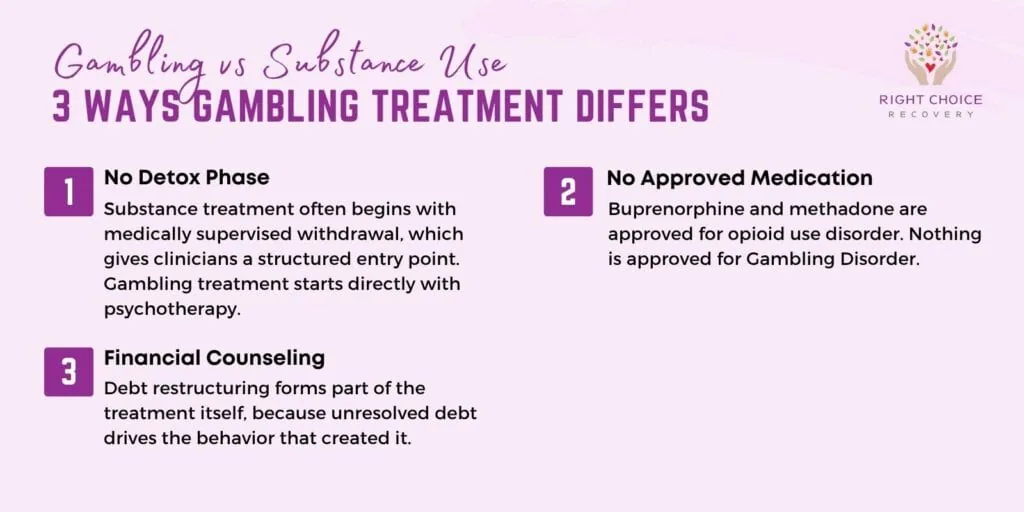
Treatment for Gambling Disorder and substance use disorder diverges at three points, and each divergence explains something about which condition is harder to treat.
Three differences shape the clinical response:
- No detox phase exists for gambling. Substance treatment often begins with medically supervised withdrawal, which gives clinicians a structured entry point. Gambling treatment has no such stage and begins directly with psychotherapy.
- No approved medication exists for gambling. Buprenorphine, methadone, and naltrexone are approved for opioid use disorder. Nothing is approved for Gambling Disorder, so psychotherapy carries the entire clinical load.
- Financial counseling is unique to gambling. Debt restructuring forms part of the treatment itself rather than an afterthought, because unresolved debt drives the behavior that created it.
The absence of a medication option is the sharper constraint. Opioid use disorder has pharmacological treatment that measurably reduces mortality, and Gambling Disorder has no equivalent.
Gambling Treatment at Right Choice Recovery
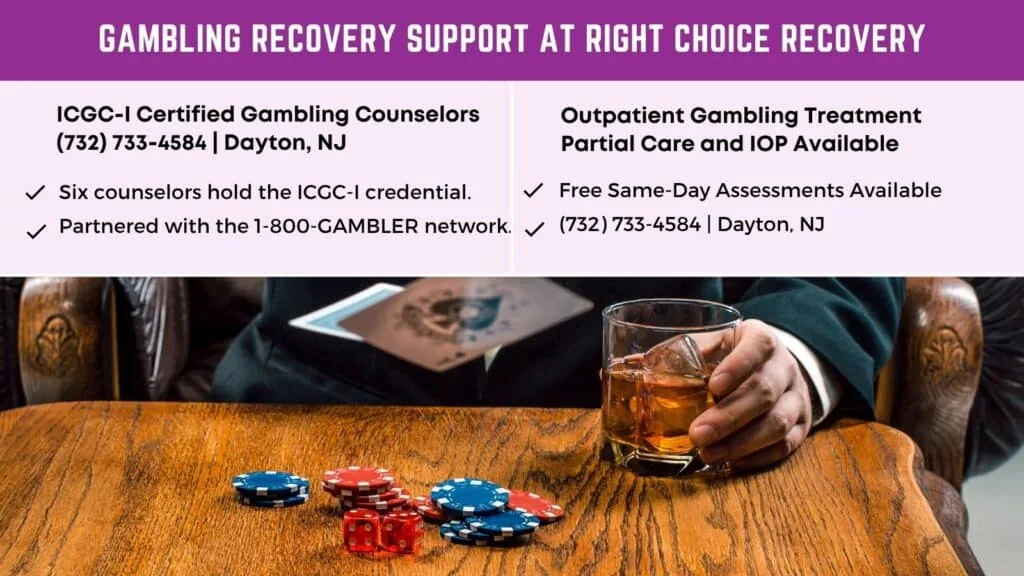
Late detection is the problem a gambling program has to solve first, and that requires clinicians trained to read financial markers rather than physical ones. Right Choice Recovery in Dayton, New Jersey, employs six counselors with the International Certified Gambling Counselor credential (ICGC-I).
The facility works alongside the Council on Compulsive Gambling of New Jersey and the 1-800-GAMBLER network, the same organisations that field the state’s first-contact calls.
Caitlin Moore, LPC, LCADC, CCS, ICGC-I, Clinical Director at Right Choice Recovery, describes the detection problem directly: “Families bring us a bank statement, not a behavior. With alcohol, someone notices six months in. With gambling, the first evidence is usually a number on a page, and by then the debt has been compounding for a year.”
Compulsive Gambling Program
The compulsive gambling program treats casino play, online betting, sports betting, and compulsive day trading. The curriculum was built by the founders alongside certified gambling counselors, and pairs CBT with practical financial recovery work.
Partial Care and Intensive Outpatient
Partial Care provides the most structured outpatient level of care, running Monday through Thursday from 9AM to 2PM and Friday from 9AM to 12PM. It suits adults whose gambling has already produced significant financial or relational damage.
The Intensive Outpatient Program reduces weekly clinical hours while maintaining group and individual therapy. Day and evening schedules allow adults to keep working while in treatment, which matters when debt repayment depends on staying employed.
Frequently Asked Questions
Are you covered for treatment?




Right Choice Recovery is in-network with Tricare and VACCN and accepts out-of-network benefits from most major commercial insurers.
Check Coverage Now!What is the worst addiction to have?
No addiction ranks worst on every measure. Opioid use disorder carries the highest overdose mortality, alcohol use disorder the most dangerous withdrawal, and Gambling Disorder the fastest financial destruction and the longest delay before detection.
Is gambling worse than drugs?
Gambling causes more financial and relational damage before discovery. Drugs cause more direct physical harm and death. The two are comparable in severity and differ in how the damage arrives.
Can a person ever stop gambling for good?
Yes. Many people reach lasting abstinence, and the diagnostic manual tracks that outcome formally rather than treating the condition as permanent. Structured treatment substantially improves the odds of getting there.
What is the hardest addiction to overcome?
Addictions whose triggers cannot be removed are hardest to overcome. Gambling ranks high on this measure because money is unavoidable, and so is the phone that now carries a casino.
Why do people keep gambling when they are losing?
Losses intensify the urge rather than reducing it. Distorted beliefs about chance, combined with unpredictable payouts, sustain betting through long losing runs.
Did you know most health insurance plans cover substance use disorder treatment? Check your coverage online now.
Is gambling addiction more common in men?
Men develop Gambling Disorder at higher rates and typically at younger ages. Rates among women have risen, and women more often present with mood disorders and suicidality alongside the gambling.
How do I know if my gambling is a problem?
Four of nine DSM-5-TR criteria within 12 months meets the diagnostic threshold. Preoccupation, rising stakes, concealment, and returning to recover losses are the signs that appear earliest.
Where can someone in New Jersey get help for gambling?
Dial or text 1-800-GAMBLER at any hour for free, confidential support statewide. The New Jersey Division of Mental Health and Addiction Services maintains a directory of gambling-specific providers across the state.
References
- American Psychiatric Association. (2022). Diagnostic and Statistical Manual of Mental Disorders (5th ed., text rev.). American Psychiatric Publishing.
- American Psychiatric Association. (2024). What is gambling disorder? Patients and Families.
- Petry, N. M., Blanco, C., Auriacombe, M., Borges, G., Bucholz, K., Crowley, T. J., Grant, B. F., Hasin, D. S., & O’Brien, C. (2014). An overview of and rationale for changes proposed for pathological gambling in DSM-5. Journal of Gambling Studies, 30(2), 493–502.
- Lorains, F. K., Cowlishaw, S., & Thomas, S. A. (2011). Prevalence of comorbid disorders in problem and pathological gambling: Systematic review and meta-analysis of population surveys. Addiction, 106(3), 490–498.
- Kessler, R. C., Hwang, I., LaBrie, R., Petukhova, M., Sampson, N. A., Winters, K. C., & Shaffer, H. J. (2008). DSM-IV pathological gambling in the National Comorbidity Survey Replication. Psychological Medicine, 38(9), 1351–1360.
- Nower, L., Stanmyre, J. F., & Anthony, V. (2023). The prevalence of online and land-based gambling in New Jersey. Rutgers Center for Gambling Studies.
- Suurvali, H., Hodgins, D., Toneatto, T., & Cunningham, J. (2008). Treatment seeking among Ontario problem gamblers: Results of a population survey. Psychiatric Services, 59(11), 1343–1346.
- Clark, L. (2014). Disordered gambling: The evolving concept of behavioral addiction. Annals of the New York Academy of Sciences, 1327, 46–61.
- Erevik, E. K., Pallesen, S., Mentzoni, R. A., et al. (2024). Association between gambling disorder and suicide mortality: A comparative cohort study using Norwegian health registry data. The Lancet Regional Health, Europe.
- New Jersey Department of Human Services, Division of Mental Health and Addiction Services. (n.d.). Gambling crisis resources.
Share This Post