What Is Gambling Psychology? Distortions Behind Betting
Gambling psychology is the study of how the brain’s reward system and a set of predictable thinking errors keep a person betting, even while losing. It explains why the pull to place one more bet grows stronger after a loss rather than weaker.
In New Jersey, 5.6 percent of adults screen as high-risk problem gamblers, roughly three times the national rate. That figure comes from the 2023 Rutgers Center for Gambling Studies prevalence report.
Three forces produce the pattern. A reward system tuned to uncertainty, betting products built around unpredictable payouts, and a cluster of distorted beliefs about luck and control.
Key Takeaways
- Lorains, Cowlishaw, and Thomas found in their 2011 Addiction meta-analysis that 57.5 percent of people with problem gambling also meet criteria for a substance use disorder.
- Potenza and colleagues estimated in Nature Reviews Disease Primers in 2019 that gambling disorder affects 0.5 percent of United States adults, far below New Jersey’s rate.
- Gambling Disorder is the only behavioral addiction in the DSM-5-TR’s Substance-Related and Addictive Disorders chapter, requiring 4 of 9 criteria within 12 months.
Did you know most health insurance plans cover substance use disorder treatment? Check your coverage online now.
What Is Gambling Psychology?
Gambling psychology examines the neurological, behavioral, and cognitive processes that separate recreational play from clinical gambling addiction.
Is Gambling Disorder a Real Mental Illness?
Yes. The DSM-5-TR classifies Gambling Disorder under Substance-Related and Addictive Disorders, and the ICD-11 codes it as 6C50 under disorders due to addictive behaviours.
Why Does Gambling Become Compulsive?
Compulsive gambling develops when four forces converge: reward-system conditioning, inherited vulnerability, environmental access, and untreated psychiatric conditions.
How Does Dopamine Drive Gambling Behavior?
Gambling releases dopamine along the mesolimbic pathway connecting the midbrain to the ventral striatum. Repeated exposure blunts that response, so larger stakes become necessary to produce the same excitement.
Wolfram Schultz established the mechanism. Dopamine neurons fire when an outcome exceeds prediction and pause when it falls short, a signal called reward prediction error. Gambling generates prediction errors continuously.
Dopamine is not a simple cause, and this is where most coverage goes wrong. Luijten, Schellekens, Kühn, Machielse and Sescousse found in their 2017 meta-analysis in JAMA Psychiatry that striatal activity in Gambling Disorder is reduced during reward outcome.
Positron emission tomography studies have not shown altered striatal D2 or D3 receptor density. The brain chemistry involved is a dysregulated reward circuit, not a dopamine surplus.
Why Does Uncertainty Feel Better Than Winning?
Dopamine activation tracks uncertainty rather than reward size. Fiorillo, Tobler and Schultz demonstrated in their 2003 study in Science that dopamine firing rises with uncertainty and peaks when reward probability sits at 0.5.
Contact us today to schedule an initial assessment or to learn more about our services. Whether you are seeking intensive outpatient care or simply need guidance on your mental health journey, we are here to help.
What Raises the Risk of Gambling Disorder?
Genetics carry substantial weight. Davis, Slutske, Martin, Agrawal and Lynskey reported in their 2019 twin-study replication in Psychological Medicine that heritability of disordered gambling reaches approximately 60 percent.
Access supplies the rest. New Jersey recorded $6.30 billion in gaming revenue during 2024, including $2.39 billion online, according to the New Jersey Division of Gaming Enforcement. Phone access removes the friction that once limited exposure.
Which Conditions Co-Occur With Gambling Disorder?
Four psychiatric conditions co-occur with Gambling Disorder at elevated rates:
- Substance use disorder, 57.5 percent. Both recruit the same mesolimbic reward circuitry and share trait impulsivity.
- Mood disorders, 37.9 percent. Betting functions as emotion regulation, and the Swelogs study found depression precedes onset in many women.
- Anxiety disorders, 37.4 percent. Betting produces arousal that displaces anxious rumination, reinforcing the behavior.
- Attention-deficit/hyperactivity disorder. Response disinhibition lowers the threshold at which an impulse becomes a bet.
Treating Gambling Disorder without treating the co-occurring condition leaves the driver intact.
What Are the Three Pathways Into Gambling Disorder?
Blaszczynski and Nower identified three pathways into Gambling Disorder in Addiction in 2002:
- Behaviourally conditioned. No prior psychiatric condition exists. Conditioning, distorted beliefs, and easy access drive the progression.
- Emotionally vulnerable. Depression, anxiety, or childhood adversity precede the gambling, which then serves as escape.
- Antisocial impulsivist. Trait impulsivity drives the earliest onset and the most severe course.
All three begin with availability. Clinicians separate action gamblers, who favor perceived-skill games, from escape gamblers, who favor continuous play.
What Cognitive Distortions Drive Compulsive Betting?
A cognitive distortion is a systematic reasoning error that survives evidence. Six distortions do the heaviest work in compulsive betting: the gambler’s fallacy, the hot-hand fallacy, the illusion of control, the near-miss effect, chasing losses, and superstitious conditioning.
The Gambler’s Fallacy
The gambler’s fallacy is the belief that an outcome becomes due after a streak of opposite results. A person watching eight reds bets black, reasoning the wheel owes a correction. Roulette has no memory.
Kahneman and Tversky traced this error to the representativeness heuristic, the expectation that short sequences mirror long-run probability.
Rediscover Life at Right Choice Recovery
Get the compassionate health support you deserve. We're here to help you reclaim joy, wellness, and a brighter future.
Our Facility
The Hot-Hand Fallacy
The hot-hand fallacy inverts the gambler’s fallacy. A winning streak signals more wins ahead, so the person raises the stake mid-run. Ayton and Fischer showed in 2004 that people apply the hot hand to human performance and the gambler’s fallacy to mechanical chance.
The Illusion of Control
The illusion of control is the belief that personal action influences a random outcome. Ellen Langer demonstrated it in her 1975 study in the Journal of Personality and Social Psychology, finding that participants demanded higher resale prices for lottery tickets they had chosen themselves.
Choosing numbers, throwing dice harder, and running a betting system all express the same distortion.
The Near-Miss Effect
A near miss is a close call that resembles a win, such as two matching symbols with the third one position short. Clark, Lawrence, Astley-Jones and Gray found in their 2009 study in Neuron that near misses recruit win-related striatal and anterior insula circuitry and increase the desire to keep playing.
The effect holds only when the player perceives control. Slot reels are engineered to produce near misses at rates above chance.
Chasing Losses
Chasing losses means returning to gamble specifically to recover money already lost, sustained by the sunk-cost fallacy. DSM-5-TR lists chasing as criterion 6, and it separates disordered play from recreational play more reliably than any other behavior.
Superstitious Conditioning
Superstitious conditioning produces rituals the person believes influence outcomes. Skinner described the mechanism as accidental reinforcement, where a behavior coinciding with a reward becomes linked to it. A lucky seat persists because a win once followed it.
Are you covered for treatment?






Right Choice Recovery is in-network with Tricare and VACCN and accepts out-of-network benefits from most major commercial insurers.
Check Coverage Now!How Do Slot Machines and Betting Apps Keep People Playing?
Gambling products are engineered around reinforcement schedules that sustain play independently of whether the person is winning.
What Is a Variable Ratio Reinforcement Schedule?
A variable ratio reinforcement schedule delivers a reward after an unpredictable number of responses. B.F. Skinner established that this schedule produces the highest steady response rate and the greatest resistance to extinction.
Slot machines, loot boxes, and in-play sports betting all run on variable ratio schedules, which is why betting persists through long unrewarded stretches.
What Are Losses Disguised as Wins?
Losses disguised as wins are multi-line slot outcomes that return less than the amount staked while triggering the celebratory sound and animation of a win. Mike Dixon and colleagues documented sessions in which 59 of 301 spins were losses the machine presented as wins. The felt win rate rises while the bankroll falls.
What Is Dark Flow?
Dark flow is a pleasurable dissociative absorption during continuous slot play, often described as losing track of time. Dixon and colleagues reported in 2017 that dark flow correlates with depression scores and problem-gambling severity.
How Does Gambling Disorder Progress Over Time?
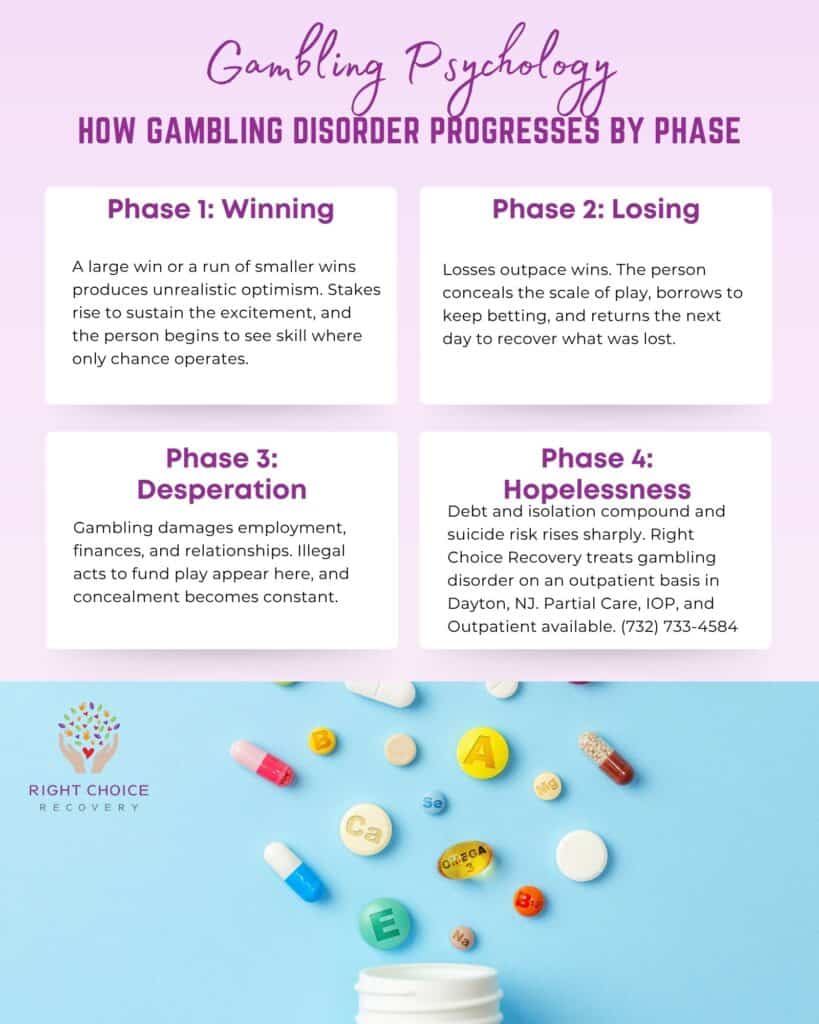
Robert L. Custer, who opened the first inpatient program for compulsive gambling in 1972, described three phases. Later descriptions added a fourth, documented in the National Research Council’s 1999 review.
- Winning phase. A large win produces unrealistic optimism, and stakes rise to sustain it.
- Losing phase. Losses outpace wins, the person conceals the scale of play, and borrowing starts.
- Desperation phase. Gambling damages employment, finances, and relationships, and illegal acts appear.
- Hopelessness phase. Debt and isolation compound, and suicide risk rises.
DSM-5-TR specifies the course as episodic or persistent. Remission is specified as early, meaning no criteria met for 3 to under 12 months, or sustained, meaning none met for 12 months or longer.
Did you know most health insurance plans cover substance use disorder treatment? Check your coverage online now.
How Is Gambling Disorder Diagnosed?
A clinician diagnoses Gambling Disorder when a person meets 4 or more of the 9 DSM-5-TR criteria within 12 months, and the behavior is not better explained by a manic episode.
What Are the Nine DSM-5-TR Criteria?
The nine criteria for Gambling Disorder are:
- Needing increasing amounts of money to reach the desired excitement (tolerance).
- Feeling restless or irritable when cutting down or stopping.
- Making repeated unsuccessful attempts to control gambling.
- Remaining preoccupied with gambling between sessions.
- Gambling when distressed rather than for entertainment.
- Returning another day to recover losses.
- Lying to conceal the extent of gambling.
- Jeopardising a relationship, job, or education.
- Relying on others for money to relieve gambling debts.
Criterion count sets severity. Mild is 4 to 5 criteria, moderate is 6 to 7, and severe is 8 to 9.
Which Screening Tools Measure Gambling Severity?
| Tool | Items | Cutoff | What it measures |
|---|---|---|---|
| South Oaks Gambling Screen (SOGS) | 20 | 5 or higher | Probable disordered gambling |
| Problem Gambling Severity Index (PGSI) | 9 | 8 or higher | Severity; 3 to 7 indicates moderate risk |
| Brief Biosocial Gambling Screen (BBGS) | 3 | Any positive | Whether full evaluation is warranted |
| Lie/Bet Questionnaire | 2 | Any positive | Rapid triage in primary care |
| Yale-Brown Obsessive Compulsive Scale Modified for Pathological Gambling (PG-YBOCS) | Clinician-rated | Change score | Urge intensity during treatment |
The SOGS carries a documented false-positive rate, so clinicians pair every screen with a structured diagnostic interview.
What Are the Signs and Effects of Compulsive Gambling?
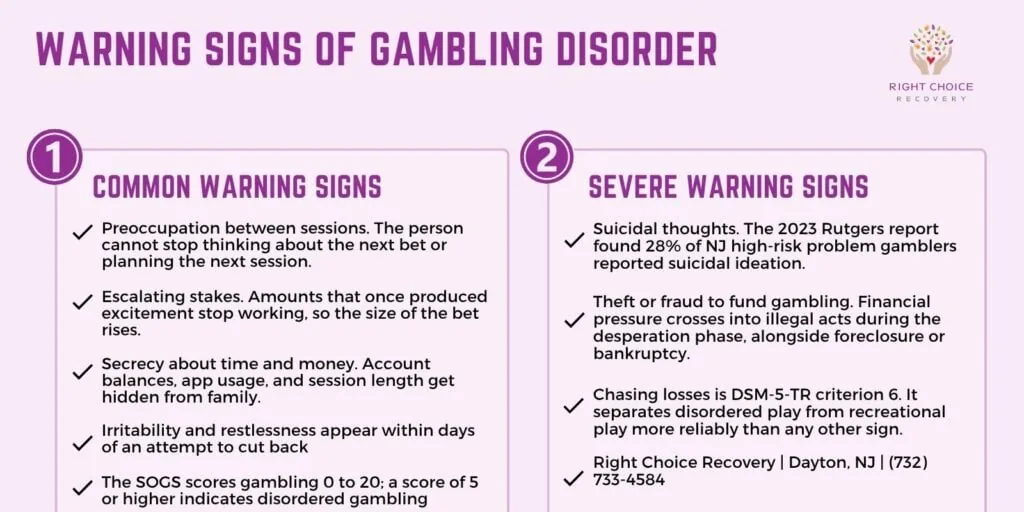
Signs of Gambling Disorder appear across three tiers of severity.
Common Signs of a Gambling Problem
Five signs appear earliest:
- Preoccupation between sessions. The person cannot stop thinking about the next bet.
- Escalating stakes. Amounts that once produced excitement stop working, so the stake rises.
- Secrecy about time and money. Account balances, app usage, and session length get hidden.
- Irritability when cutting back. Restlessness appears within days of stopping.
- Borrowing to fund play. Credit cards and loans replace spare income.
Contact us today to schedule an initial assessment or to learn more about our services. Whether you are seeking intensive outpatient care or simply need guidance on your mental health journey, we are here to help.
Severe Signs and Emergency Warning Signs
Four signs require immediate clinical attention:
- Suicidal thoughts. The 2023 Rutgers report found 28 percent of New Jersey high-risk problem gamblers reported suicidal ideation and 20 percent reported an attempt.
- Self-injury. The same report found 26 percent reported non-suicidal self-injury.
- Theft or fraud. Financial pressure crosses into illegal acts during the desperation phase.
- Financial collapse. Foreclosure, bankruptcy, or loss of retirement savings.
Anyone experiencing thoughts of suicide can reach the 988 Suicide and Crisis Lifeline by call or text at any hour. The Council on Compulsive Gambling of New Jersey operates 1-800-GAMBLER.
Long-Term Consequences of Gambling Disorder
Three consequences compound over years:
- Compounding debt. Interest outpaces income, sustaining the chasing behavior that created the debt.
- Relationship and employment loss. Concealment erodes trust before financial damage becomes visible.
- Entrenched comorbidity. Depression and substance use deepen, and each raises relapse risk for the other.
Gambling Disorder vs Recreational Gambling
Five betting patterns look alike from outside and differ sharply on control, chasing, and impairment.
| Pattern | Control over stakes | Chasing losses | Impairment |
|---|---|---|---|
| Recreational gambling | Intact, preset limits hold | Absent | None |
| Professional gambling | Intact, bankroll managed | Absent | None |
| Gambling Disorder | Impaired | Present | Significant |
| Gambling during a manic episode | Impaired only during the episode | Variable | Confined to the episode |
| Dopamine agonist-induced gambling | Impaired while medicated | Present | Resolves on dose reduction |
DSM-5-TR excludes a separate Gambling Disorder diagnosis when gambling occurs only during manic episodes. Dopamine agonists prescribed for Parkinson’s disease, specifically pramipexole and ropinirole, precipitate compulsive gambling that resolves once the dose drops.
How Is Gambling Disorder Treated?
Gambling Disorder responds to structured psychotherapy, with medication used off-label for urges and co-occurring conditions treated in parallel.
First-Line Therapies
Four psychotherapies carry the strongest evidence:
- Cognitive Behavioral Therapy (CBT). CBT restructures the six distortions above and holds the largest evidence base.
- Motivational Interviewing (MI). MI resolves ambivalence before behavior change begins.
- Imaginal desensitisation. Imagined exposure reduces cue reactivity to venues and betting apps.
- Gamblers Anonymous. The 12-step model supplies peer accountability beside clinical care.
Rediscover Life at Right Choice Recovery
Get the compassionate health support you deserve. We're here to help you reclaim joy, wellness, and a brighter future.
Our FacilityMedications Used for Gambling Disorder
No medication holds FDA approval for Gambling Disorder. Every agent below is prescribed off-label.
Opioid antagonists carry the strongest support. Naltrexone and nalmefene block mu-opioid receptors and reduce urge intensity measured on the PG-YBOCS, with larger benefit in people reporting strong urges.
Selective serotonin reuptake inhibitors such as paroxetine and fluvoxamine have produced mixed results. Lithium applies where bipolar-spectrum illness co-occurs, and N-acetylcysteine shows preliminary findings through its action on glutamate.
Second-Line and Adjunct Support
Four supports extend treatment beyond the therapy hour:
- Acceptance and Commitment Therapy (ACT). ACT targets urge tolerance, not urge elimination.
- Financial counselling. Debt restructuring removes the pressure driving chasing behavior.
- Self-exclusion. The New Jersey Division of Gaming Enforcement runs a statewide self-exclusion list.
- Family therapy. Sessions rebuild the financial boundaries concealment destroyed.
Emerging and Investigational Treatments
Four treatments are under active investigation:
- Repetitive transcranial magnetic stimulation (rTMS). Targets the dorsolateral prefrontal cortex; small trials only.
- Transcranial direct current stimulation (tDCS). Early-stage investigational status.
- Virtual reality cue-exposure therapy. In active clinical trials.
- N-acetylcysteine and glutamatergic agents. Phase 2-level evidence.
Gambling Treatment at Right Choice Recovery
Six clinicians at Right Choice Recovery in Dayton, New Jersey hold the International Certified Gambling Counselor credential (ICGC-I), a certification most outpatient programs do not staff for.
Caitlin Moore, LPC, LCADC, CCS, ICGC-I, Clinical Director at Right Choice Recovery, describes the clinical problem this way: “The betting stops before the thinking does. A client can be three weeks abstinent and still be running the math on a system that never worked.”
Compulsive Gambling Program
The compulsive gambling program delivers CBT-based distortion work through ICGC-I credentialed clinicians, with screening for the substance use and mood conditions that co-occur in most cases.
Are you covered for treatment?
Right Choice Recovery is in-network with Tricare and VACCN and accepts out-of-network benefits from most major commercial insurers.
Check Coverage Now!Partial Care
Partial Care is the most structured outpatient level of care at Right Choice Recovery, for adults whose gambling has reached the losing or desperation phase.
Intensive Outpatient Program
The Intensive Outpatient Program reduces weekly clinical hours while maintaining group and individual therapy, suiting adults stepping down from Partial Care.
Adolescent Gambling Program
The adolescent gambling program addresses the teenage pathway, where loot boxes and betting apps supply variable ratio reinforcement years before legal gambling age.
Frequently Asked Questions
Can gambling disorder be cured?
No. Gambling Disorder is managed rather than cured, and DSM-5-TR measures progress through remission. Sustained remission means no criteria met for 12 months or longer.
Did you know most health insurance plans cover substance use disorder treatment? Check your coverage online now.
Does the brain recover after gambling addiction?
Reward-system responsiveness and prefrontal control improve with sustained abstinence and treatment. The direction of recovery is documented; a fixed timeline is not, because pace varies with severity.
Why are young men at the highest risk of gambling problems?
Young men combine higher trait impulsivity with the heaviest exposure to sports betting apps. Health record analyses in states that legalised sports betting show the sharpest diagnosis rise among adults 18 to 29.
Can teenagers develop a gambling disorder?
Yes. Loot boxes deliver the same variable ratio reinforcement as slot machines, conditioning betting behavior before legal gambling age. Adolescent onset predicts a more severe adult course.
What does a gambling urge feel like?
Most people describe intrusive thoughts about the next bet, restlessness, and narrowed attention. Clinicians call this cue reactivity, and it intensifies on exposure to apps or paydays.
Is gambling disorder an impulse control disorder?
Not in current terms. DSM-IV classified it as an impulse-control disorder until 2013, when DSM-5 reclassified it as an addictive disorder based on shared neurobiology with substance use disorders.
Contact us today to schedule an initial assessment or to learn more about our services. Whether you are seeking intensive outpatient care or simply need guidance on your mental health journey, we are here to help.
Does sports betting cause gambling addiction?
Sports betting does not cause the disorder, but continuous in-play wagering supplies unlimited variable ratio reinforcement. Access converts vulnerability into disorder faster than venue-based gambling.
How do I help someone with a gambling problem?
Name the behavior you have observed rather than the label, and offer to help arrange an assessment. Do not cover gambling debts, which removes the consequence driving the person toward treatment.
References
- American Psychiatric Association. (2022). Diagnostic and Statistical Manual of Mental Disorders (5th ed., text rev.). American Psychiatric Publishing.
- Blaszczynski, A., & Nower, L. (2002). A pathways model of problem and pathological gambling. Addiction, 97(5), 487–499.
- Clark, L., Lawrence, A. J., Astley-Jones, F., & Gray, N. (2009). Gambling near-misses enhance motivation to gamble and recruit win-related brain circuitry. Neuron, 61(3), 481–490.
- Davis, C. N., Slutske, W. S., Martin, N. G., Agrawal, A., & Lynskey, M. T. (2019). Genetic and environmental influences on gambling disorder liability: A replication and combined analysis of two twin studies. Psychological Medicine, 49(10), 1705–1712.
- Dixon, M. J., Stange, M., Larche, C. J., Graydon, C., Fugelsang, J. A., & Harrigan, K. A. (2017). Dark flow, depression and multiline slot machine play. Journal of Gambling Studies, 34(1), 73–84.
- Fiorillo, C. D., Tobler, P. N., & Schultz, W. (2003). Discrete coding of reward probability and uncertainty by dopamine neurons. Science, 299(5614), 1898–1902.
- Langer, E. J. (1975). The illusion of control. Journal of Personality and Social Psychology, 32(2), 311–328.
- Lorains, F. K., Cowlishaw, S., & Thomas, S. A. (2011). Prevalence of comorbid disorders in problem and pathological gambling: Systematic review and meta-analysis of population surveys. Addiction, 106(3), 490–498.
- Luijten, M., Schellekens, A. F., Kühn, S., Machielse, M. W. J., & Sescousse, G. (2017). Disruption of reward processing in addiction: An image-based meta-analysis of functional magnetic resonance imaging studies. JAMA Psychiatry, 74(4), 387–398.
- National Research Council. (1999). Pathological gambling: A critical review. National Academies Press.
- Nower, L., Stanmyre, J. F., & Anthony, V. (2023). The prevalence of online and land-based gambling in New Jersey. Rutgers Center for Gambling Studies.
- Potenza, M. N., Balodis, I. M., Derevensky, J., Grant, J. E., Petry, N. M., Verdejo-Garcia, A., & Yip, S. W. (2019). Gambling disorder. Nature Reviews Disease Primers, 5(1), 51.
Share This Post