Can Gambling Addiction Be Cured?
No, gambling addiction has no cure, but it is a treatable condition, and most people who stay in care reach long-term remission. Psychiatrists measure that progress in months without gambling problems, not in a single finish line.
The question behind "can gambling addiction be cured" is usually a personal one: will the urge to bet ever stop running the day? For most people, the urge fades into the background with treatment, support and time, while the habits that protect recovery stay in place for good.
The answer starts with what doctors mean by remission.
Key Takeaways
- Gambling disorder goes into early remission after 3 months and sustained remission after 12 months without meeting any of its 9 diagnostic criteria, according to the DSM-5-TR.
- 74.2% of reassessed outpatients had recovered from gambling disorder after 1 year and 78.9% after 2 years in a French study by Challet-Bouju and colleagues, published in the Journal of Gambling Studies in 2025.
- Cognitive behavioral therapy (CBT) has the strongest research support of any gambling treatment, though its measured benefits shrink in the months after therapy ends.
- No medication is approved by the U.S. Food and Drug Administration (FDA) for gambling disorder. Naltrexone, approved for alcohol and opioid use disorders, is prescribed off-label.
- Outpatient and intensive outpatient care treat gambling disorder while a person lives at home. Inpatient care is reserved for a crisis or severe co-occurring conditions.
What does "cured" mean for gambling disorder?
For gambling disorder, the medical equivalent of "cured" is remission: a period in which a person meets none of the 9 diagnostic criteria for gambling disorder. The DSM-5-TR, published by the American Psychiatric Association, defines 2 stages of remission.
- Early remission: none of the 9 criteria met for at least 3 months but less than 12 months, after a full diagnosis.
- Sustained remission: none of the 9 criteria met for 12 months or longer.
Remission describes the condition, not a guarantee. The DSM-5-TR also describes an "episodic" course, in which a person meets the criteria at more than one point with symptom-free months in between.
"Remission does not mean the work is finished. The thinking that got someone into gambling cannot be the same thinking that gets them out, so long-term recovery runs on honesty, accountability and asking for help early, before a bad day turns into a bet."
Rob Sackowitz, CEO and founder of Right Choice Recovery
What is the difference between remission and recovery?
Remission is a clinical measurement of symptoms, while recovery is the daily practice that keeps a person in remission. A clinician confirms remission by checking the 9 criteria. Recovery covers the rest of life: honest money habits, repaired relationships, support meetings and a plan for high-risk moments.
Remission, rather than a cure, is the goal because gambling addiction behaves like a long-term condition.
Why is gambling addiction treated as a long-term condition?
Gambling addiction is treated as a long-term condition because relapse is common in the first year and the benefits of therapy fade without ongoing support. Both findings come from studies that followed people for months after they stopped.
Hodgins and el-Guebaly (2004), in the Journal of Consulting and Clinical Psychology, followed 101 people who had recently quit gambling for 12 months. Only 8% stayed completely gamble-free for the full year. Relapses happened most often in the evening, when a person was alone and thinking about money, and good moods came before a relapse as often as bad ones.
Treatment research shows the same pattern. A 2023 meta-analysis in the journal Addiction found that CBT produced large gains right after treatment but no significant effect at later follow-up. A 2012 Cochrane review found only 1 trial that measured CBT 9 to 12 months later, leaving its long-term effect unknown.
Ongoing gambling relapse prevention strategies fill that gap after formal therapy ends.
Relapse risk does not make recovery rare, as studies that follow people for 1 to 2 years show.
How many people recover from gambling addiction?
Most people who stay engaged in treatment recover from gambling addiction, even though slips in the first year are common. The studies below measure recovery in different groups, which explains why their numbers differ so widely.
| Study | Who was studied | Finding |
|---|---|---|
| Challet-Bouju et al. (2025), Journal of Gambling Studies | 237 adults starting outpatient gambling disorder treatment in France, of whom 97 were reassessed at 1 year and 71 at 2 years | 74.2% of those reassessed had recovered at 1 year and 78.9% at 2 years |
| Slutske (2006), American Journal of Psychiatry | Two U.S. national surveys of adults with lifetime pathological gambling | 36% to 39% had no gambling problems in the past year; only 7% to 12% had ever sought treatment or attended Gamblers Anonymous |
| Afifi, Cox and Sareen (2006), letter in the American Journal of Psychiatry | The same national survey, recounted | Recovery without any treatment fell from 34% to 18% once treatment for alcohol or mood problems was counted, a reading Slutske disputed in a published reply |
| Hodgins and el-Guebaly (2004), Journal of Consulting and Clinical Psychology | 101 people who had recently quit gambling | 8% stayed completely gamble-free for 12 months |
Read together, these studies show that a single slip is common and does not decide the outcome. Recovery rates are highest in people who stay connected to treatment. In New Jersey, about 6% of adults surveyed showed high-risk problem gambling in a 2023 Rutgers report on gambling prevalence in New Jersey.
Recovery rates depend on the treatments people receive and how long they stay engaged with them.
What are the treatments for gambling addiction?
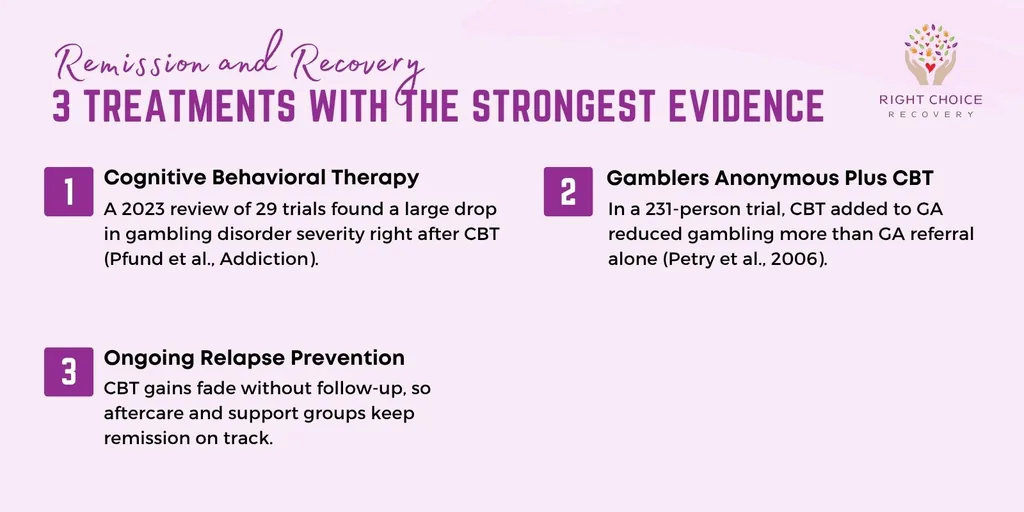
The 5 main treatments for gambling addiction are cognitive behavioral therapy, motivational interviewing, group therapy with Gamblers Anonymous, family therapy and off-label medication. Cognitive behavioral therapy is the best-supported of the 5, and most programs combine several treatments for gambling addiction rather than relying on one.
Cognitive behavioral therapy
Cognitive behavioral therapy treats gambling addiction by changing the beliefs that keep a person betting, such as "a win is due" or "one more bet will fix the debt." Cowlishaw and colleagues' 2012 Cochrane review of 14 trials with 1,245 participants found that CBT reduced gambling severity in the first 3 months after treatment.
The Cochrane authors rated that evidence as low or very low quality, so the true effect is likely smaller than measured.
Pfund and colleagues (2023) pooled 29 randomized trials with 3,991 participants in the journal Addiction. CBT techniques produced a large drop in gambling disorder severity after treatment (Hedges' g = -1.14), with no significant effect at follow-up.
Motivational interviewing
Motivational interviewing treats gambling addiction by helping a person name their own reasons to stop and resolve mixed feelings about change. The 2012 Cochrane review found early evidence that motivational interviewing reduced money lost and how often people gambled.
Group therapy and Gamblers Anonymous
Group therapy and Gamblers Anonymous (GA) support gambling recovery by giving people a peer group that understands chasing, debt and lying from experience.
Petry and colleagues (2006) randomly assigned 231 people with pathological gambling to 3 groups: GA referral alone, GA plus a CBT workbook, or GA plus 8 individual CBT sessions. CBT reduced gambling more than GA referral alone during treatment, and both GA attendance and completed CBT work were linked to abstinence.
The research supports using both, which is why support groups for gambling addiction recovery work best alongside professional therapy rather than instead of it.
Family therapy
Family therapy supports gambling recovery by repairing trust, setting money boundaries and teaching partners and parents how to respond to a slip. Gambling harms the people closest to the person who gambles, so family members often need their own support during treatment.
Medication
Medication plays a supporting role in gambling addiction treatment, because the FDA has approved no drug for gambling disorder. Naltrexone, an opioid antagonist approved for alcohol and opioid use disorders, is prescribed off-label for gambling disorder. Nalmefene, a related opioid antagonist, has been tested for gambling disorder in clinical trials.
Grant, Kim and Hartman (2008) found naltrexone reduced gambling urges and behavior more than placebo in an 18-week trial of 77 people. Grant and colleagues (2006) found 59.2% improved on 25 mg of nalmefene, compared with 34.0% on placebo.
Treatments for gambling addiction are delivered at several levels of care, from weekly sessions to round-the-clock hospital care.
Which level of care fits?
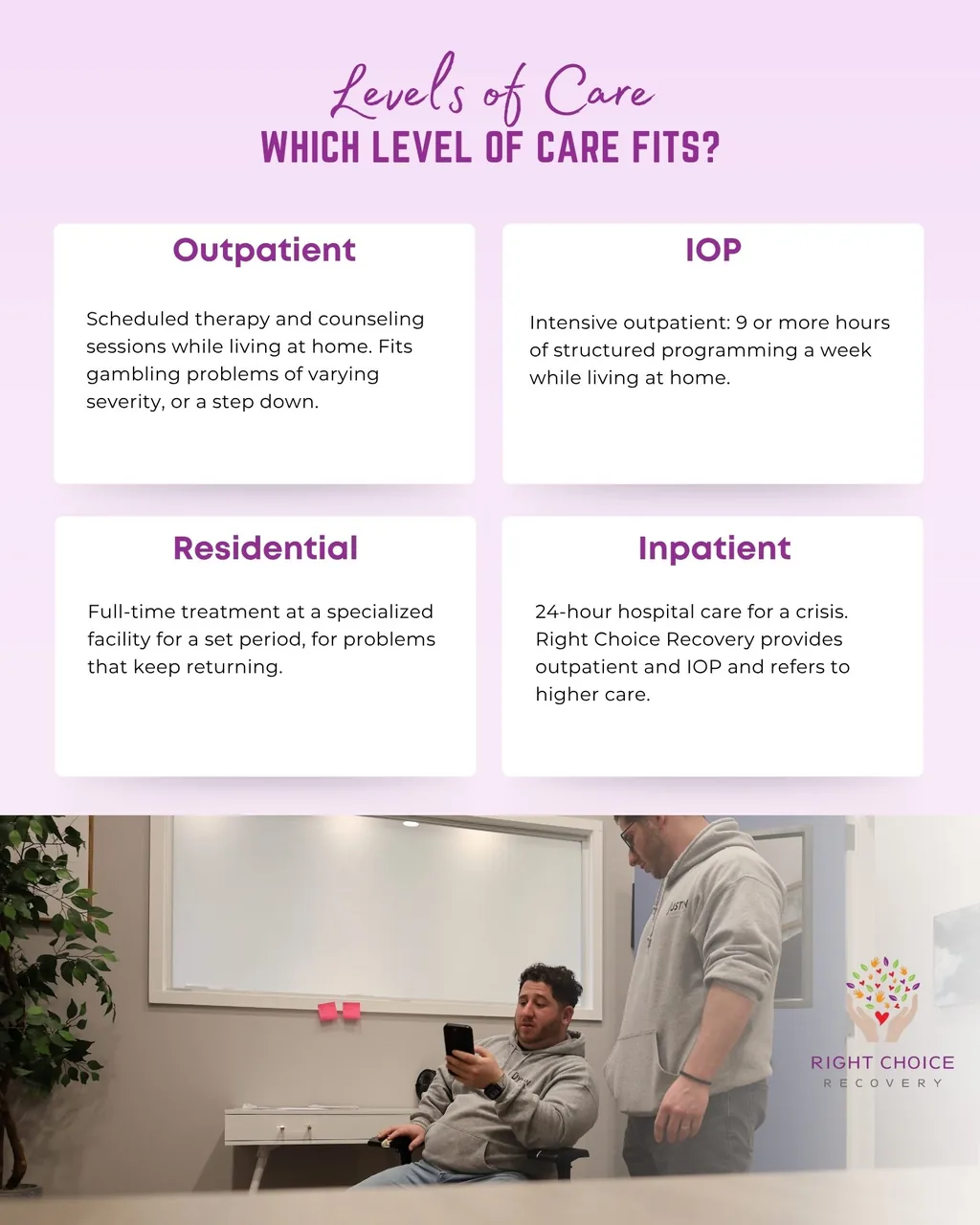
The right level of care for gambling addiction depends on severity, safety and whether outpatient therapy has already been tried. The National Council on Problem Gambling describes outpatient, residential and inpatient care for gambling disorder, with intensive outpatient programs as a more structured form of outpatient care.
| Level of care | Setting | Time in treatment | Who it fits |
|---|---|---|---|
| Outpatient | Lives at home, attends sessions | Scheduled therapy and counseling sessions | Gambling problems of varying severity, or a step down after more intensive care |
| Intensive outpatient | Lives at home, attends structured programming | 9 or more hours a week | Moderate to severe problems in a person who can stay safe at home |
| Residential | A specialized treatment facility | A set period of full-time treatment | Severe problems that keep returning despite outpatient care |
| Inpatient | Hospital setting | 24 hours a day, 7 days a week | A psychiatric crisis or medical need for round-the-clock care |
Outpatient gambling treatment lets a person keep working and living at home while practicing new skills in real life. An intensive outpatient program adds structure for people who need more than weekly sessions.
When does someone need inpatient care?
Someone with gambling addiction needs inpatient care when there is a risk of suicide, a severe co-occurring mental health or substance use condition, or repeated relapse at lower levels.
Right Choice Recovery provides outpatient and intensive outpatient care and refers clients to a higher level of care when their safety requires it. A person in crisis can call, text or chat with 988 at any hour, at 988lifeline.org.
Outpatient and intensive outpatient care are the 2 levels of gambling care Right Choice Recovery provides.
How does Right Choice Recovery support long-term gambling recovery?
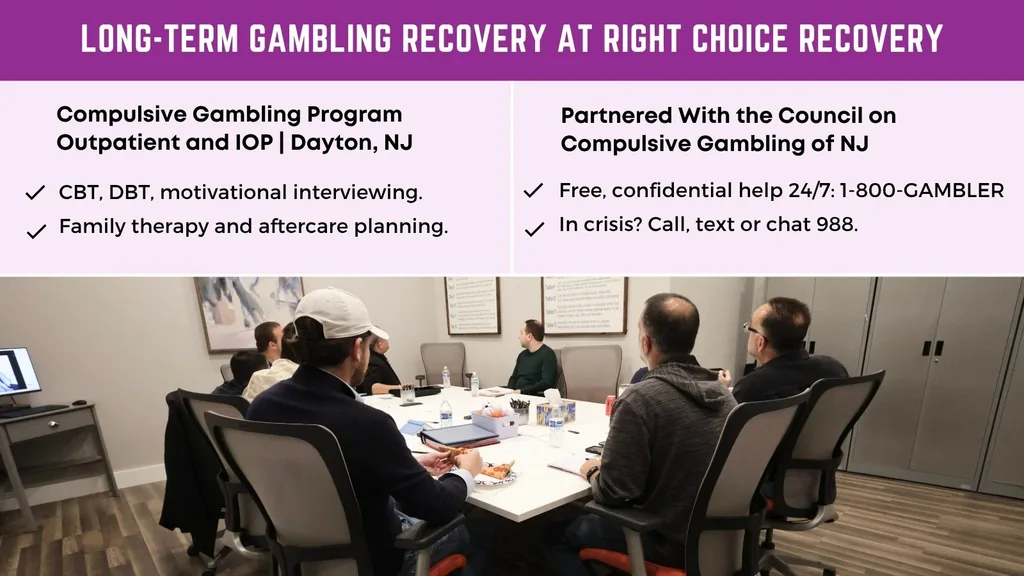
Right Choice Recovery supports long-term gambling recovery with a dedicated compulsive gambling program at the outpatient and intensive outpatient levels, followed by individualized aftercare planning. The program is built on 12-step recovery principles and on founder Rob Sackowitz's own recovery.
Clients receive gambling addiction treatment in New Jersey that combines CBT, dialectical behavior therapy (DBT), motivational interviewing and family therapy in one plan. Many staff members bring personal recovery experience to the work.
Right Choice Recovery partners with the Council on Compulsive Gambling of New Jersey and its free, confidential 24-hour helpline, 1-800-GAMBLER. Aftercare and discharge planning continue relapse prevention after the program ends.
A confidential admissions assessment at Right Choice Recovery matches each client to outpatient or intensive outpatient gambling care.
Frequently Asked Questions
Does a gambling addiction ever go away?
A gambling addiction goes into remission rather than going away for good, and the urge to gamble fades for most people in long-term recovery. Sustained remission in the DSM-5-TR means 12 months without meeting any criterion, including constant preoccupation with gambling. Urges can still return at stressful moments, and stable finances make them easier to manage.
Why can't some people stop gambling?
Some people can't stop gambling because gambling disorder makes repeated attempts to quit fail, which is one of its 9 DSM-5-TR criteria. Chasing losses keeps the cycle going, since each loss creates a reason to bet again. Hodgins and el-Guebaly (2004) found that relapses clustered in the evening, when people were alone and thinking about money.
Is a slip the same as a relapse?
A slip is a single episode of gambling after a period of abstinence, while a relapse is a return to the old pattern of gambling. Treating a slip quickly, by telling a counselor or sponsor the same day, keeps it from becoming a relapse.
Can someone recover from gambling addiction without treatment?
Some people recover from gambling addiction without formal treatment, but the number shrinks when hidden treatment is counted. A reanalysis of U.S. survey data found recovery without any treatment dropped from 34% to 18% once help for alcohol or mood problems was included.
Is gambling addiction a mental illness?
Gambling addiction is a recognized mental health condition, diagnosed as gambling disorder in the DSM-5-TR. The DSM-5 moved it into the "Substance-Related and Addictive Disorders" chapter, alongside alcohol and drug use disorders. Gambling disorder is the only behavioral addiction in that chapter.
Can family members help someone stay in recovery?
Family members help someone stay in gambling recovery by setting clear money boundaries, avoiding bailouts and joining family therapy or Gam-Anon. Gamblers Anonymous warns that bailouts harm recovery, because paying off gambling debts shields the person from the cost of gambling.
Why do people relapse even when things are going well?
People relapse when things are going well because good moods lower their guard and can feel like a reason to celebrate. Hodgins and el-Guebaly (2004) found that positive moods came before a gambling relapse as often as negative ones, along with thoughts of winning.
References
- American Psychiatric Association. (2022). Diagnostic and statistical manual of mental disorders (5th ed., text rev.). American Psychiatric Publishing.
- Challet-Bouju, G., Caillon, J., Leboucher, J., Thiabaud, E., Saillard, A., Balem, M., & Grall-Bronnec, M. (2025). Impact of gambling on the internet on middle-term and long-term recovery from gambling disorder: A 2-year longitudinal study. Journal of Gambling Studies, 41(2), 567-592.
- Cowlishaw, S., Merkouris, S., Dowling, N., Anderson, C., Jackson, A., & Thomas, S. (2012). Psychological therapies for pathological and problem gambling. Cochrane Database of Systematic Reviews, (11), CD008937.
- Grant, J. E., Kim, S. W., & Hartman, B. K. (2008). A double-blind, placebo-controlled study of the opiate antagonist naltrexone in the treatment of pathological gambling urges. Journal of Clinical Psychiatry, 69(5), 783-789.
- Grant, J. E., Potenza, M. N., Hollander, E., et al. (2006). Multicenter investigation of the opioid antagonist nalmefene in the treatment of pathological gambling. American Journal of Psychiatry, 163(2), 303-312.
- Hodgins, D. C., & el-Guebaly, N. (2004). Retrospective and prospective reports of precipitants to relapse in pathological gambling. Journal of Consulting and Clinical Psychology, 72(1), 72-80.
- National Council on Problem Gambling. (n.d.). Problem gambling treatment options.
- Nower, L., Stanmyre, J. F., & Anthony, V. (2023). The prevalence of online and land-based gambling in New Jersey. Report to the New Jersey Division of Gaming Enforcement. Rutgers Center for Gambling Studies.
- Afifi, T. O., Cox, B. J., & Sareen, J. (2006). Gambling-related problems are chronic and persist for the majority of individuals with a lifetime diagnosis of pathological gambling (Letter). American Journal of Psychiatry, 163(7), 1297.
- Petry, N. M., Ammerman, Y., Bohl, J., et al. (2006). Cognitive-behavioral therapy for pathological gamblers. Journal of Consulting and Clinical Psychology, 74(3), 555-567.
- Pfund, R. A., Forman, D. P., Whalen, S. K., et al. (2023). Effect of cognitive-behavioral techniques for problem gambling and gambling disorder: A systematic review and meta-analysis. Addiction, 118(9), 1661-1674.
- Slutske, W. S. (2006). Natural recovery and treatment-seeking in pathological gambling: Results of two U.S. national surveys. American Journal of Psychiatry, 163(2), 297-302.
Share This Post