Gambling Addiction Withdrawal Symptoms and Timeline
Gambling addiction withdrawal symptoms are the emotional and physical reactions a person feels when cutting down or stopping gambling, most often irritability, restlessness, anxiety and poor sleep. These reactions are real, and psychiatrists count them as one of the nine signs of gambling disorder.
Gambling withdrawal has no proven day-by-day schedule. Recovery is instead measured in months, with clear milestones at 3 months and 12 months without gambling problems.
Free, confidential help is open 24 hours a day at 1-800-GAMBLER, the New Jersey helpline run by the Council on Compulsive Gambling of New Jersey. A person in crisis or thinking about suicide can call or text 988, or chat at 988lifeline.org, with Spanish and Deaf and Hard of Hearing options.
Key Takeaways
- 87% of people with a gambling problem felt restless or irritable when they tried to stop, and 91% reported cravings. Rosenthal and Lesieur published the 222-person study in the American Journal on Addictions in 1992.
- Gambling withdrawal is mostly emotional. Research contains no reports of severe, dangerous physical withdrawal from gambling, so medical detox is not part of gambling disorder care.
- No study has measured a week-by-week gambling withdrawal timeline. Schedules such as "3 to 10 days" or "peaks in week 2" circulate online without a research source.
- The DSM-5-TR defines early remission from gambling disorder at 3 months without meeting any criteria and sustained remission at 12 months.
- About 6% of New Jersey adults surveyed showed high-risk problem gambling, roughly three times the national average, in a 2023 Rutgers report to the state Division of Gaming Enforcement.
What is gambling withdrawal?
Gambling withdrawal is the distress a person with a gambling problem feels when trying to cut down or stop betting. The DSM-5-TR lists it as criterion 2 of the 9 criteria for gambling disorder: "restless or irritable when attempting to cut down or stop gambling."
The American Psychiatric Association's Diagnostic and Statistical Manual of Mental Disorders (DSM-5-TR) diagnoses gambling disorder when a person meets 4 or more of the 9 DSM-5 diagnostic criteria for gambling disorder within 12 months. Severity follows the count: 4 to 5 criteria is mild, 6 to 7 is moderate, and 8 to 9 is severe.
Gamblers Anonymous offers a quick self-check called the Gambler 20 Questions. A high score on that screen signals a gambling problem worth a clinical assessment, which is where a diagnosis is made.
Are gambling withdrawals real?
Yes, gambling withdrawals are real: withdrawal is the most central of the 9 gambling disorder criteria, according to a 2024 network analysis of 4,203 patients. Lucas and colleagues, publishing in European Psychiatry, found that restlessness or irritability when stopping linked most strongly to the other criteria in both men and women.
How many people report withdrawal depends on who is asked. Wray and Dickerson (1981) found that 30% to 40% of Gamblers Anonymous members reported marked mood or behavior changes after stopping.
Among 312 community gamblers, Cunningham-Williams and colleagues (2009) found that one quarter met the restlessness or irritability criterion, and 41% reported other withdrawal-like symptoms when trying to quit or control gambling.
Gambling withdrawal appears as a cluster of emotional and physical symptoms, and research has measured how often each one occurs.
What are the symptoms of gambling withdrawal?
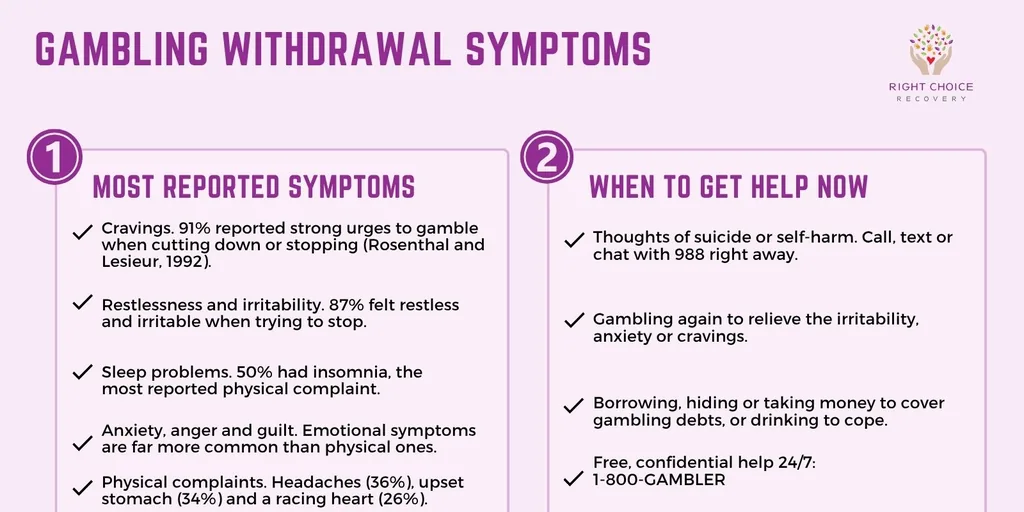
The 5 main gambling withdrawal symptoms are irritability and restlessness, anxiety and anger, sleep problems, low mood, and physical complaints such as headaches. Emotional symptoms are far more common than physical ones.
The following are the 4 most common gambling withdrawal symptoms reported by 222 people with a gambling problem in the Rosenthal and Lesieur (1992) study:
- Cravings: 91% reported strong urges to gamble when cutting down or stopping.
- Restlessness and irritability: 87% felt restless and irritable when trying to stop.
- Physical symptoms: 65% reported at least one physical symptom, compared with 2% of a comparison group.
- Insomnia: 50% had trouble sleeping, the most common physical complaint in the study.
Irritability and restlessness
Irritability and restlessness are the defining gambling withdrawal symptoms and the only ones written into the DSM-5-TR criteria. People describe feeling on edge, snapping at family members and being unable to sit still during the hours they used to spend betting.
Anxiety, anger and guilt
Anxiety, anger, guilt and disappointment form a wider set of gambling withdrawal symptoms that the DSM-5-TR criterion does not name. Cunningham-Williams and colleagues (2009) found that adding anger, guilt and disappointment to restlessness explained gambling disorder better, raising the explained variance from 41% to 54%.
Starcevic (2016), writing in the journal Addiction, described withdrawal in behavioral addictions as emotional states: irritability, restlessness, anger, moodiness, sadness, guilt, anxiety and feeling tense.
Sleep problems
Insomnia affected 50% of people with a gambling problem who tried to stop in the 1992 Rosenthal and Lesieur study, making sleep loss the most reported physical withdrawal symptom. A small Korean randomized trial of 36 people, published by Lee in 2025, tracked insomnia as a gambling withdrawal outcome over 5 weeks.
Low mood and boredom
Low mood and boredom after quitting gambling come from losing the main source of excitement and escape in a person's day. Sadness and moodiness appear on Starcevic's (2016) list of behavioral withdrawal states, and some people describe anhedonia, the inability to feel pleasure from everyday activities.
Right Choice Recovery counselors encourage clients to fill those hours with exercise, cooking, journaling, sport and helping others.
What happens to the body when someone stops gambling?
The body often reacts to stopping gambling with headaches, an upset stomach, poor appetite or a racing heart, though research contains no reports of a medically dangerous one. After insomnia, the following are the 6 most frequent physical complaints in the Rosenthal and Lesieur (1992) study:
- Headaches: 36% of participants.
- Upset stomach or diarrhea: 34% of participants.
- Loss of appetite: 29% of participants.
- Physical weakness: 27% of participants.
- Racing heart or palpitations: 26% of participants.
- Shaking: 19% of participants.
Smaller groups in the same study reported difficulty breathing (13%), sweating (12%) and chills or fever (6.5%), the same complaints people describe on gambling recovery forums.
These figures come from self-reports collected after the fact. Starcevic (2016) notes that there have been no reports of severe physical withdrawal in behavioral addictions, and that the few gambling studies reporting physical symptoms had significant methodological shortcomings.
Each of these gambling withdrawal symptoms traces back to the role gambling played in the brain and in daily life.
Why does stopping gambling cause withdrawal symptoms?
Stopping gambling causes withdrawal symptoms because the brain and daily routine have adapted to gambling as the main source of excitement and stress relief. Removing it leaves the stress, the money problems and the urge in place without the usual escape.
Blaszczynski, Walker, Sharpe and Nower (2008), writing in International Gambling Studies, found that people with pathological gambling reported withdrawal severity similar to people with alcohol dependence. The researchers left open whether the distress comes from losing gambling itself or from losing a habit used to avoid stress. Both explanations point to the same need: a new way to handle stress.
Gambling activates the brain's reward system, which is part of how gambling addiction affects the brain over months and years of betting. Rosenthal and Lesieur (1992) found that withdrawal symptoms correlated with more hours spent gambling, more severe problems and feeling detached during play. Gender, game type and alcohol or drug use made no difference.
"When the betting stops, the adrenaline goes and the consequences arrive: the sleepless nights, the racing thoughts, the debt still on the table. A couple of months in, the relief of quitting wears off and life can feel flat. That flat stretch is when we push hardest on new routines, because it is where real recovery starts."
Rob Sackowitz, CEO and founder of Right Choice Recovery
The same causes of gambling withdrawal shape how long its symptoms last.
How long does gambling withdrawal last?
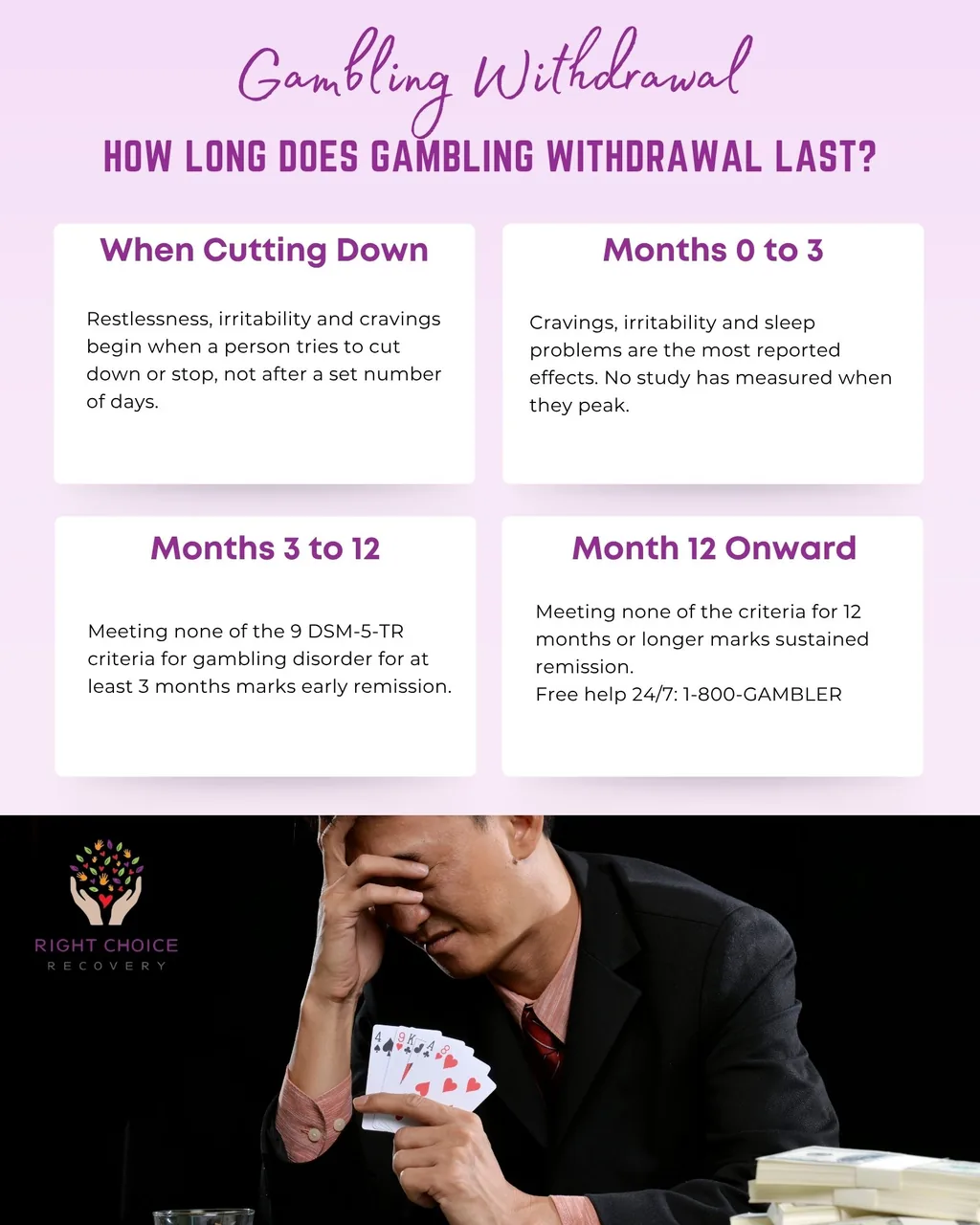
No study has measured how long gambling withdrawal lasts, so no reliable day-by-day or week-by-week timeline exists. A 2020 systematic review of 47 abstinence studies by Fernandez, Kuss and Griffiths in Clinical Psychology Review found few prospective studies of what happens when people stop a behavioral addiction such as gambling.
The gambling withdrawal timeline below uses only what research and the DSM-5-TR establish. Each stage describes what is known, not a predicted symptom level.
| Stage | What is known | Source |
|---|---|---|
| When cutting down or stopping | Restlessness, irritability and cravings begin when a person tries to cut down or stop, not after a set number of days. | DSM-5-TR; Rosenthal and Lesieur (1992) |
| Months 0 to 3 | Cravings, irritability and sleep problems are the most reported withdrawal effects. No research has measured when they peak. | Rosenthal and Lesieur (1992); Fernandez, Kuss and Griffiths (2020) |
| Months 3 to 12 | A person who meets none of the 9 criteria for at least 3 months is in early remission. | DSM-5-TR |
| Month 12 onward | A person who meets none of the criteria for 12 months or longer is in sustained remission. | DSM-5-TR |
Week-by-week schedules published online, such as "acute withdrawal lasts 3 to 10 days" or "urges peak in weeks 2 to 4", cite no study. Several borrow the idea of post-acute withdrawal from alcohol and drug research, where it was measured, and apply it to gambling, where it was not.
What makes gambling withdrawal stronger?
Gambling withdrawal is stronger in people who gambled more often, more intensely and with more severe problems.
Wray and Dickerson (1981) found greater disturbance in Gamblers Anonymous members who bet at the last moment or became extremely excited during races, and in those who found it hardest to stop suddenly. Rosenthal and Lesieur (1992) found symptoms correlated with more hours spent gambling.
The intensity of gambling withdrawal matters more than its length when deciding whether to get professional help.
When does gambling withdrawal need professional help?
Gambling withdrawal needs professional help when distress leads back to betting, to drinking or drug use, or to thoughts of self-harm. Emotional warning signs deserve the same urgency as physical ones.
The following are the 5 warning signs that gambling withdrawal needs help now:
- Having thoughts of suicide or self-harm, which needs an immediate call, text or chat to 988.
- Gambling again to relieve the irritability, anxiety or cravings.
- Borrowing, hiding or taking money to cover gambling debts.
- Drinking or using drugs to cope with the distress.
- Going several nights in a row with little or no sleep.
Short-term coping skills help during the first weeks, and Right Choice Recovery has published practical steps to stop gambling for that stage.
Gambling withdrawal vs depression
Gambling withdrawal and depression overlap, but depression does not fully explain withdrawal symptoms. Cunningham-Williams and colleagues (2009) found depressive symptoms in 34% of their sample and showed that withdrawal-like symptoms still predicted gambling disorder after accounting for them. Low mood that lasts most of the day for 2 weeks or more needs a mental health assessment.
Professional help for gambling withdrawal is delivered in outpatient care, without detox or a hospital stay.
How does Right Choice Recovery help with gambling withdrawal?
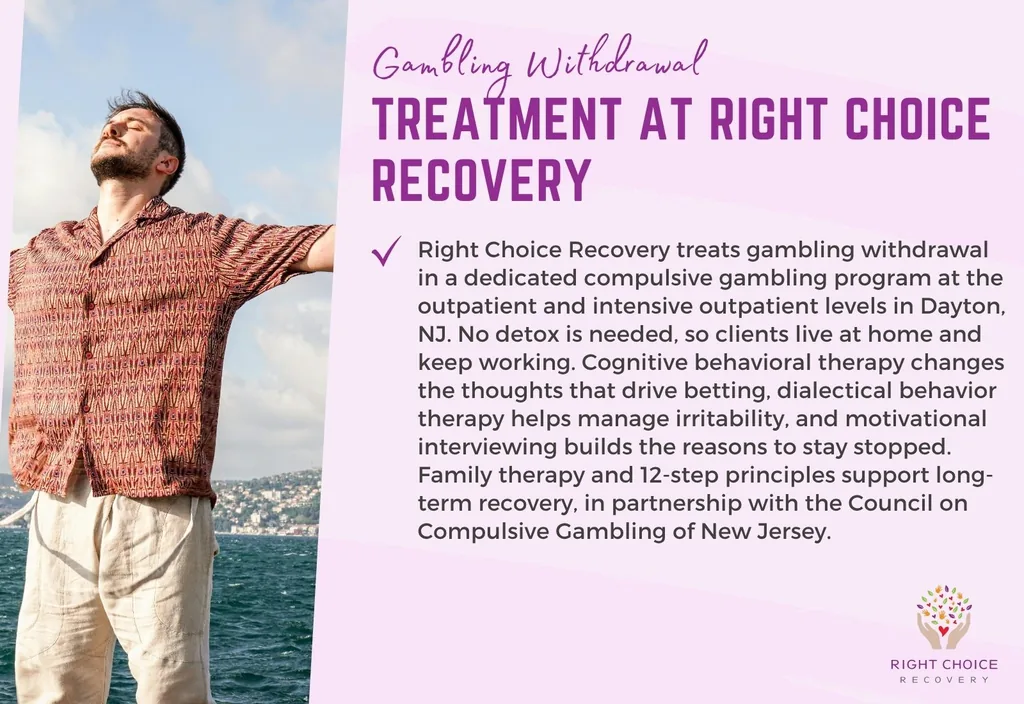
Right Choice Recovery helps people through gambling withdrawal with a dedicated compulsive gambling program at the outpatient and intensive outpatient levels in Dayton, New Jersey. Gambling withdrawal does not require detox, so clients keep living at home and working while they attend.
The compulsive gambling program uses cognitive behavioral therapy (CBT) to change the thoughts that drive betting, dialectical behavior therapy (DBT) to manage irritability and distress, and motivational interviewing to build the reasons to stay stopped. Family therapy brings partners and parents into the process, and the program follows 12-step recovery principles.
Right Choice Recovery partners with the Council on Compulsive Gambling of New Jersey and 1-800-GAMBLER. Many staff members are in recovery themselves, including founder Rob Sackowitz.
A confidential admissions assessment at Right Choice Recovery is the first step into the compulsive gambling program.
Frequently Asked Questions
What does gambling withdrawal feel like?
Gambling withdrawal feels like being on edge for no clear reason: restless, short-tempered, anxious and unable to switch off at night. Many people also feel flat or bored, because nothing replaces the rush of a bet. Guilt and disappointment about past losses often arrive at the same time.
Is gambling withdrawal dangerous?
Gambling withdrawal is not physically dangerous the way alcohol or benzodiazepine withdrawal can be, because research contains no reports of severe physical withdrawal from gambling. The emotional risk is real. Anyone having thoughts of suicide during gambling withdrawal should call, text or chat with 988 right away.
Is gambling withdrawal the same as drug or alcohol withdrawal?
Gambling withdrawal is not the same as drug or alcohol withdrawal, because no substance leaves the body and no medical detox is needed. Blaszczynski and colleagues (2008) still found that people with a gambling problem rated their withdrawal as severe as people with alcohol dependence.
Do men and women experience gambling withdrawal differently?
Men and women both experience gambling withdrawal as a core feature of gambling disorder. In the 2024 Lucas study of 4,203 patients, withdrawal was the most central criterion for both sexes. The second most central criterion differed: tolerance in men and chasing losses in women.
Is gambling withdrawal caused by dopamine?
Gambling withdrawal involves the brain's dopamine reward system, but no study has shown a timed dopamine "reset" after quitting. Researchers including Blaszczynski (2008) also point to the loss of gambling as a way to escape stress. Both explanations shape how the urge feels.
Can gambling urges return after months without betting?
Gambling urges can return after months without betting, often in the evening, when a person is alone or worried about money. Hodgins and el-Guebaly (2004) followed 101 people who had recently quit and found these were the most common settings for relapse, and good moods came before relapse as often as bad ones.
References
- American Psychiatric Association. (2022). Diagnostic and statistical manual of mental disorders (5th ed., text rev.). Gambling disorder criteria as reproduced by the Connecticut Department of Mental Health and Addiction Services.
- Blaszczynski, A., Walker, M., Sharpe, L., & Nower, L. (2008). Withdrawal and tolerance phenomenon in problem gambling. International Gambling Studies, 8(2), 179-192.
- Cunningham-Williams, R. M., Gattis, M. N., Dore, P. M., Shi, P., & Spitznagel, E. L. (2009). Towards DSM-V: Considering other withdrawal-like symptoms of pathological gambling disorder. International Journal of Methods in Psychiatric Research, 18(1), 13-22.
- Fernandez, D. P., Kuss, D. J., & Griffiths, M. D. (2020). Short-term abstinence effects across potential behavioral addictions: A systematic review. Clinical Psychology Review, 76, 101828.
- Hodgins, D. C., & el-Guebaly, N. (2004). Retrospective and prospective reports of precipitants to relapse in pathological gambling. Journal of Consulting and Clinical Psychology, 72(1), 72-80.
- Lucas, I., Mora-Maltas, B., Granero, R., et al. (2024). Network analysis of DSM-5 criteria for gambling disorder: Considering sex differences in a large clinical sample. European Psychiatry, 67(1), e65.
- Nower, L., Stanmyre, J. F., & Anthony, V. (2023). The prevalence of online and land-based gambling in New Jersey. Report to the New Jersey Division of Gaming Enforcement. Rutgers Center for Gambling Studies.
- Rosenthal, R. J., & Lesieur, H. R. (1992). Self-reported withdrawal symptoms and pathological gambling. American Journal on Addictions, 1(2), 150-154.
- Starcevic, V. (2016). Tolerance and withdrawal symptoms may not be helpful to enhance understanding of behavioural addictions. Addiction, 111(7), 1307-1308.
- Wray, I., & Dickerson, M. G. (1981). Cessation of high frequency gambling and "withdrawal" symptoms. British Journal of Addiction, 76(4), 401-405.
Share This Post