
Medication for Gambling Addiction: What Works
Medication for gambling addiction exists and is prescribed, but no drug holds regulatory approval for gambling disorder in any country. Every prescription is off-label.
Opioid antagonists carry the strongest trial evidence. Naltrexone and nalmefene reduce gambling urges more reliably than any other class tested.
New Jersey funds this work directly. The Department of Human Services awarded $720,000 across up to six gambling-disorder clinician grants in its FY2025 cycle.
What follows covers which drugs have been tested, at what doses, and what the trials actually found. Every figure comes from a published randomised controlled trial or a systematic review.
Key Takeaways
- Grant, Odlaug and Schreiber reported in their 2014 review that no medication has received regulatory approval for gambling disorder in any jurisdiction.
- The 2022 Cochrane review of 17 randomised trials found opioid antagonists outperformed placebo at a standardised mean difference of −0.46, while antidepressants and mood stabilisers did not.
- Kim and colleagues recorded 75 percent improvement on naltrexone against 24 percent on placebo in the first double-blind trial of the drug for gambling.
- Medication works alongside cognitive behavioural therapy rather than replacing it. No trial has shown medication alone outperforming structured psychotherapy.
Did you know most health insurance plans cover substance use disorder treatment? Check your coverage online now.
Is There a Medication for Gambling Addiction?
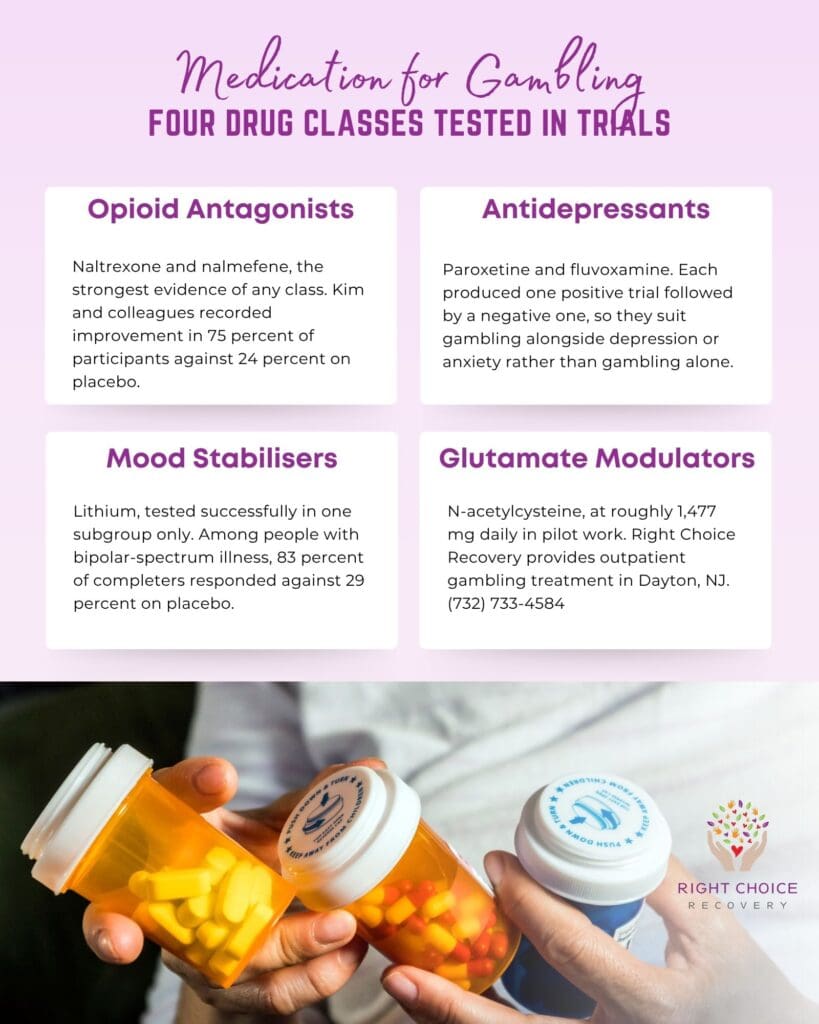
Yes. Six medications have randomised controlled trial evidence in gambling disorder: naltrexone, nalmefene, paroxetine, fluvoxamine, lithium, and N-acetylcysteine. None carries an FDA indication for gambling addiction.
Those six fall into four drug classes:
- Opioid antagonists: naltrexone and nalmefene. The strongest evidence of any class, and the closest thing to a first-line option.
- Antidepressants: paroxetine and fluvoxamine. Both selective serotonin reuptake inhibitors, with results that have not replicated.
- Mood stabilisers: lithium. Tested successfully in one subgroup, people with bipolar-spectrum illness.
- Glutamate modulators: N-acetylcysteine. A supplement-grade compound with pilot trial support.
Three further drugs were tested and failed: bupropion, olanzapine and topiramate. Each is covered below, because knowing what did not work matters as much as knowing what did.
Off-label prescribing means a physician prescribes a drug approved for a different condition, based on clinical judgment and published trial evidence rather than an FDA label. Naltrexone, for example, is approved for alcohol and opioid use disorders.
Why Is No Medication FDA-Approved for Gambling Disorder?
No pharmaceutical company has sought an FDA indication for gambling disorder, and the trial base is too small and too inconsistent to support one.
This is a commercial gap rather than a scientific verdict. Absence of approval does not mean absence of evidence, and the distinction matters for anyone weighing whether to raise medication with a doctor.
Three factors explain the gap:
- Trials have been small. Massachusetts state treatment guidance notes that some randomised trials in this field enrolled as few as four participants.
- Results have not replicated. Paroxetine and fluvoxamine each produced one positive trial followed by a negative one at similar doses.
- The diagnosis is recent. Gambling Disorder only entered the addictions chapter of the DSM in 2013, which is a short window for a drug development pipeline.
Off-label prescribing is legal and common across medicine. It does affect two practical things: insurance coverage becomes less predictable, and the prescriber works from trial data rather than an approved label. No New Jersey statute or insurer guidance specifically addresses coverage of off-label prescribing for gambling disorder, so verify benefits before starting.
Which Medications Have the Strongest Evidence?
Opioid antagonists carry the strongest evidence. Every other class tested is either weaker, unreplicated, or failed outright. The table below lists the doses used in published trials, which are research doses rather than prescribing instructions.
| Medication | Class | Doses used in trials | Evidence | Best suited to |
|---|---|---|---|---|
| Naltrexone | Opioid antagonist | 50 to 188 mg/day | Two positive RCTs | Strong urges, family history of alcohol problems |
| Nalmefene | Opioid antagonist | 25 mg/day | One positive, one negative RCT | Strong urges where naltrexone is unsuitable |
| Paroxetine | SSRI | 10 to 60 mg/day | One positive, one negative RCT | Co-occurring depression or anxiety |
| Fluvoxamine | SSRI | Around 200 mg/day | One positive, one negative RCT | Co-occurring depression or anxiety |
| Lithium | Mood stabiliser | Serum level around 0.87 mEq/L | One positive RCT | Bipolar-spectrum illness |
| N-acetylcysteine | Glutamate modulator | Around 1,477 mg/day | One pilot with blinded phase | Poor tolerance of other agents |
Opioid Antagonists
Naltrexone and nalmefene block opioid receptors, which dampens dopamine release in the reward circuit and reduces the excitement attached to betting.
The two differ in receptor targeting. Naltrexone acts mainly on mu-opioid receptors, while nalmefene binds mu and kappa receptors at similar strength.
Kim, Grant, Adson and Shin published the first double-blind naltrexone trial in Biological Psychiatry in 2001. At a mean effective dose of 188 mg daily, 75 percent of participants improved significantly against 24 percent on placebo.
Grant, Kim and Hartman followed in 2008 in the Journal of Clinical Psychiatry, comparing fixed doses of 50, 100 and 150 mg. The 50 mg dose proved as effective as the higher ones, and 39.7 percent on naltrexone abstained for at least a month against 10.5 percent on placebo.
Grant and colleagues identified the clearest responder signal in Psychopharmacology that same year. A family history of alcoholism most robustly predicted who responded to naltrexone, and strong gambling urges predicted response as well.
Nalmefene produced mixed results. Grant and colleagues reported in the American Journal of Psychiatry in 2006 that 25 mg daily produced improvement in 59.2 percent of participants against 34.0 percent on placebo, while 50 and 100 mg caused intolerable side effects. A larger 2010 trial found no difference from placebo.
Antidepressants
SSRI results are mixed and have not replicated. Each drug produced one positive trial followed by a negative one.
Kim and colleagues found paroxetine effective in 2002, with 61 percent improving against 23 percent on placebo. Grant and colleagues ran a larger multicentre trial the following year and found no separation from placebo, with a high placebo response rate.
Fluvoxamine followed the same pattern. Hollander and colleagues reported benefit in 2000; Blanco and colleagues found none in 2002. Sertraline showed no advantage over placebo in the Sáiz-Ruiz trial in 2005.
Clinicians use SSRIs where gambling sits alongside depression or anxiety, treating the co-occurring condition rather than the gambling itself.
Contact us today to schedule an initial assessment or to learn more about our services. Whether you are seeking intensive outpatient care or simply need guidance on your mental health journey, we are here to help.
Mood Stabilisers
Lithium has trial support in one specific group. Hollander and colleagues studied 40 people with bipolar-spectrum illness and pathological gambling, publishing in the American Journal of Psychiatry in 2005.
At a mean serum level of 0.87 mEq/L, 83 percent of those who completed the trial responded against 29 percent on placebo. Improvement in gambling tracked improvement in mania ratings.
Lithium carries a monitoring burden. Prescribers check serum levels regularly alongside baseline renal and thyroid testing.
The trial recruited only people with bipolar-spectrum illness, so the result does not extend to gambling disorder generally. It is evidence for a subgroup, not for everyone.
Glutamate-Modulating Agents
N-acetylcysteine showed promise in a pilot study by Grant, Kim and Odlaug, published in Biological Psychiatry in 2007. Titrated to a mean of roughly 1,477 mg daily, 59 percent of participants responded.
Responders then entered a blinded phase. 83.3 percent on N-acetylcysteine held their response against 28.6 percent moved to placebo. Side effects were mainly gastrointestinal.
Medications That Failed in Trials
Three agents did not separate from placebo in controlled trials:
- Bupropion. Black and colleagues found 36 percent responded on bupropion against 47 percent on placebo in 2007.
- Olanzapine. Two separate 2008 trials, by McElroy and by Fong, both returned negative results.
- Topiramate. Berlin and colleagues found no significant effect on primary or secondary outcomes in 2011.
One tension is worth naming. The Cochrane review found atypical antipsychotics beneficial as a pooled class, yet both individual olanzapine trials were negative. Pooled class estimates and individual drug results do not always agree, and a reader deciding what to ask about deserves to know which agents have already failed.
What Are the Side Effects and Monitoring Requirements?
Each medication used for gambling disorder carries its own monitoring requirements, and one of them is safety-critical.
What Gets Monitored
Four monitoring requirements apply across the commonly used agents:
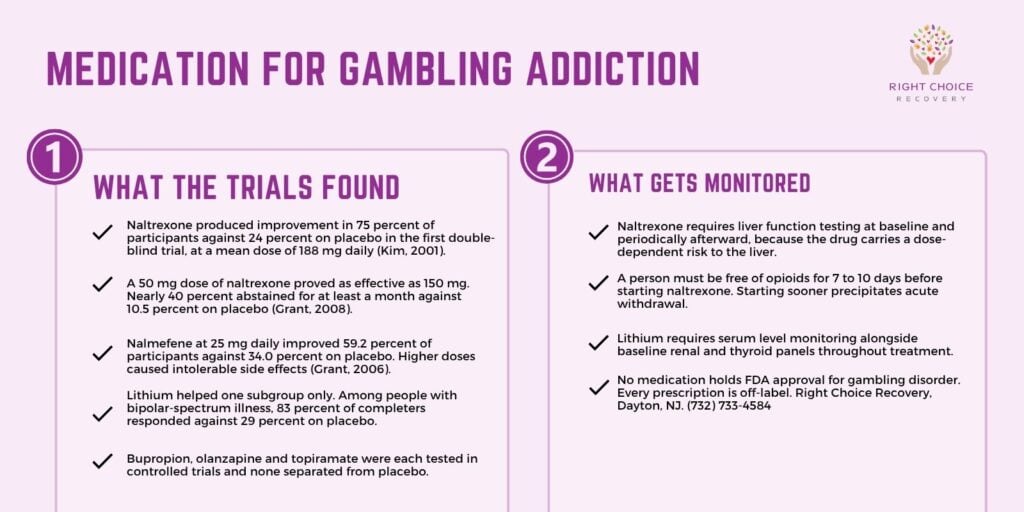
- Naltrexone requires liver testing. Prescribers check liver function at baseline and periodically afterward. A person must be free of opioids for 7 to 10 days before starting, because naltrexone precipitates acute withdrawal in anyone with opioids in their system.
- Lithium requires blood levels. Serum lithium monitoring runs alongside baseline renal and thyroid panels.
- SSRIs follow standard antidepressant monitoring. Prescribers review mood and side effects during the first weeks.
- N-acetylcysteine is generally well tolerated. Gastrointestinal upset is the most commonly reported effect.
Naltrexone’s common side effects are nausea, headache, dizziness and insomnia. These concentrate in the first two weeks and usually settle.
Rediscover Life at {mb_website-settings_var_company_name}
Get the compassionate health support you deserve. We're here to help you reclaim joy, wellness, and a brighter future.
Our Facility
What to Ask Your Prescriber
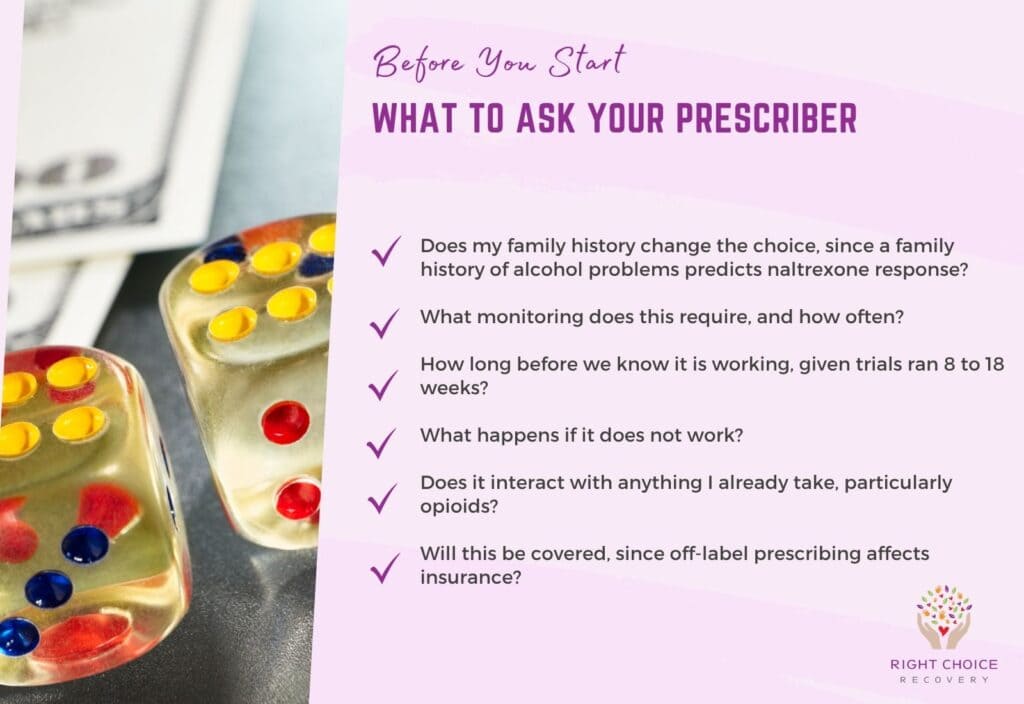
Six questions are worth bringing to the appointment:
- Does my family history change the choice? A family history of alcohol problems predicts naltrexone response.
- What monitoring does this require? Ask what gets tested and how often.
- How long before we know it is working? Trials ran between 8 and 18 weeks.
- What happens if it does not work? Ask what the next option would be.
- Does it interact with anything I take? Disclose all current prescriptions, particularly opioids.
- Will this be covered? Off-label prescribing affects insurance coverage.
Does Medication Work Better Than Therapy?
No. Cognitive behavioural therapy holds the stronger evidence base, and medication performs best alongside it rather than instead of it.
Dowling, Merkouris, Lubman, Thomas, Bowden-Jones and Cowlishaw examined 17 randomised trials covering 1,193 participants for the Cochrane Database in 2022. Opioid antagonists beat placebo at a standardised mean difference of −0.46, with a confidence interval running from −0.74 to −0.19.
Antidepressants and mood stabilisers showed no advantage over placebo. The reviewers rated the certainty of all this evidence as low to very low.
A 2024 network meta-analysis in Comprehensive Psychiatry reached similar conclusions, placing nalmefene at −0.87 and naltrexone at −0.43 against placebo.
One finding deserves particular weight. An earlier meta-analysis measured a large before-and-after effect for medication at Hedges g of 1.35, which fell to 0.41 when the analysis was restricted to randomised controlled trials. Most of the apparent benefit disappears under rigorous design.
Two things follow from this. Anyone offered medication as a standalone answer is being offered the weaker half of the evidence, and anyone refusing medication on the grounds that therapy alone is enough is turning down a measurable advantage.
The practical reading is straightforward. Medication reduces urges enough that cognitive behavioral therapy has something workable to address.
What If the First Medication Does Not Work?
A first medication failing is common and does not end the pathway. Prescribers work through a recognised sequence.
- Confirm the trial was adequate. Published trials ran 8 to 18 weeks. Judging a medication after two weeks judges it too early.
- Reassess co-occurring conditions. Untreated depression, anxiety or a substance use disorder will undercut any gambling medication.
- Consider switching class. A person who failed an SSRI may fit the opioid antagonist profile, particularly with a family history of alcohol problems.
- Confirm psychotherapy is running alongside. Medication without therapy is the weakest configuration in the evidence.
Trials define response as roughly a 30 to 35 percent reduction on the Yale-Brown Obsessive Compulsive Scale Modified for Pathological Gambling (PG-YBOCS). Response means a meaningful drop in urges and behaviour, not necessarily complete abstinence.
Can Medication Cause Compulsive Gambling?
Yes, and this is a separate situation from everything above. Dopamine agonists prescribed for Parkinson’s disease and restless legs syndrome, specifically pramipexole and ropinirole, precipitate new-onset compulsive gambling in some patients.
This form is iatrogenic, meaning the treatment caused it. It typically resolves once the dose is reduced or the drug is stopped.
Nobody should stop a prescribed medication on their own. Raise the gambling with the prescriber who wrote it.
Gambling Treatment at Right Choice Recovery
New Jersey’s 2025 Governor’s Task Force on responsible gaming flagged a shortage of clinicians qualified to treat gambling disorder. Against that backdrop, the ICGC-I credential held by six of the clinical team in Dayton is worth stating plainly.
Right Choice Recovery does not prescribe medication. The relevance of everything above is that therapy and prescribing have to be coordinated, and a program that understands the evidence coordinates better.
Caitlin Moore, LPC, LCADC, CCS, ICGC-I, Clinical Director at Right Choice Recovery, puts medication in context: “Medication quiets the urge enough that someone can do the work. It does not do the work. The clients who hold their gains are the ones who used that quieter period to change how they think about a bet.”
Are you covered for treatment?


{mb_website-settings_var_company_name} is an approved provider for Blue Cross Blue Shield and Cigna, while also accepting many other major insurance carriers.
Check Coverage Now!Compulsive Gambling Program
The compulsive gambling program builds on CBT delivered by ICGC-I credentialed clinicians. Compulsive day trading is treated alongside casino play, online betting and sports betting. The program operates in partnership with the Council on Compulsive Gambling of New Jersey.
Coordinating Medication With Outpatient Care
Right Choice Recovery delivers Partial Care and Intensive Outpatient programming. Clients already prescribed medication continue under their prescriber while therapy addresses the beliefs and behaviours driving the gambling.
Frequently Asked Questions
Is there a pill that stops gambling urges?
No pill stops urges outright. Naltrexone reduced urge intensity more than placebo in two randomised trials, which means fewer and weaker urges rather than none.
How long does someone take medication for gambling disorder?
Published trials ran between 8 and 18 weeks. No trial has established an optimal long-term duration, so prescribers make that decision case by case.
Did you know most health insurance plans cover substance use disorder treatment? Check your coverage online now.
Does the benefit last after stopping the medication?
Evidence is limited. In the N-acetylcysteine study, 28.6 percent of responders moved to placebo held their response against 83.3 percent who continued the drug.
Will a regular doctor prescribe medication for gambling?
Some will and some will refer to a psychiatrist. Because prescribing is off-label, familiarity varies widely between clinicians. Bringing published trial evidence to the appointment helps.
Is naltrexone or nalmefene better for gambling?
Naltrexone has more consistent trial support, with two positive randomised trials. Nalmefene produced one positive and one negative trial and is not approved in the United States.
What medication helps someone who gambles and drinks?
Naltrexone is approved for alcohol use disorder and has the strongest gambling evidence, which makes it the logical candidate. A family history of alcohol problems also predicts better response.
Do drugs like semaglutide help gambling addiction?
No completed randomised controlled trial has tested GLP-1 medications for gambling disorder. Current interest rests on anecdote and on studies of substance use, not gambling.
Contact us today to schedule an initial assessment or to learn more about our services. Whether you are seeking intensive outpatient care or simply need guidance on your mental health journey, we are here to help.
How does naltrexone reduce gambling urges?
Naltrexone blocks opioid receptors, which reduces dopamine release in the reward circuit. That lowers the excitement a bet produces, and with it the drive to place the next one.
References
- American Psychiatric Association. (2022). Diagnostic and Statistical Manual of Mental Disorders (5th ed., text rev.). American Psychiatric Publishing.
- Black, D. W., Arndt, S., Coryell, W. H., Argo, T., Forbush, K. T., Shaw, M. C., Perry, P., & Allen, J. (2007). Bupropion in the treatment of pathological gambling: A randomized, double-blind, placebo-controlled, flexible-dose study. Journal of Clinical Psychopharmacology, 27(2), 143–150.
- Dowling, N., Merkouris, S., Lubman, D., Thomas, S., Bowden-Jones, H., & Cowlishaw, S. (2022). Pharmacological interventions for the treatment of disordered and problem gambling. Cochrane Database of Systematic Reviews, 9(9), CD008936.
- Grant, J. E., Kim, S. W., Potenza, M. N., Blanco, C., Ibáñez, A., Stevens, L., Hektner, J. M., & Zaninelli, R. (2003). Paroxetine treatment of pathological gambling: A multi-centre randomized controlled trial. International Clinical Psychopharmacology, 18(4), 243–249.
- Grant, J. E., Potenza, M. N., Hollander, E., Cunningham-Williams, R., Nurminen, T., Smits, G., & Kallio, A. (2006). Multicenter investigation of the opioid antagonist nalmefene in the treatment of pathological gambling. American Journal of Psychiatry, 163(2), 303–312.
- Grant, J. E., Kim, S. W., & Odlaug, B. L. (2007). N-acetyl cysteine, a glutamate-modulating agent, in the treatment of pathological gambling: A pilot study. Biological Psychiatry, 62(6), 652–657.
- Grant, J. E., Kim, S. W., & Hartman, B. K. (2008). A double-blind, placebo-controlled study of the opiate antagonist naltrexone in the treatment of pathological gambling urges. Journal of Clinical Psychiatry, 69(5), 783–789.
- Grant, J. E., Odlaug, B. L., & Schreiber, L. R. N. (2014). Pharmacological treatments in pathological gambling. British Journal of Clinical Pharmacology, 77(2), 375–381.
- Hollander, E., Pallanti, S., Allen, A., Sood, E., & Baldini Rossi, N. (2005). Does sustained-release lithium reduce impulsive gambling and affective instability versus placebo in pathological gamblers with bipolar spectrum disorders? American Journal of Psychiatry, 162(1), 137–145.
- Kim, S. W., Grant, J. E., Adson, D. E., & Shin, Y. C. (2001). Double-blind naltrexone and placebo comparison study in the treatment of pathological gambling. Biological Psychiatry, 49(11), 914–921.
- Kim, S. W., Grant, J. E., Adson, D. E., Shin, Y. C., & Zaninelli, R. (2002). A double-blind placebo-controlled study of the efficacy and safety of paroxetine in the treatment of pathological gambling. Journal of Clinical Psychiatry, 63(6), 501–507.
- New Jersey Department of Human Services, Division of Mental Health and Addiction Services. (2025). Gambling disorder clinician services.
Share This Post
