Is Fantasy Football Gambling? PrizePicks and Pick'em Apps
Yes, paid fantasy football is a form of gambling, because players stake money on uncertain player results in the hope of winning a bigger prize. The law calls qualifying fantasy contests games of skill, but that legal label decides who is allowed to run them, not how risky they are.
Fantasy football now comes in 3 formats: season-long leagues, daily fantasy contests and pick'em apps. Pick'em apps work the most like sports betting. A free league among friends, with no entry fee and no prize, is not gambling under New Jersey rules.
The difference between the formats explains why some players stay casual and others lose control. Free, confidential help is open 24 hours a day at 1-800-GAMBLER, the New Jersey problem gambling helpline.
Key Takeaways
- 17.2% of New Jersey adults who gambled in the past year played season-long fantasy sports, and 13.0% played daily fantasy sports. The figures come from a 2023 Rutgers Center for Gambling Studies report to the state Division of Gaming Enforcement.
- 66.4% of New Jersey's high-risk problem gamblers played daily fantasy sports, compared with 4.7% of gamblers with no gambling problem, in the same Rutgers survey.
- Federal law excludes qualifying fantasy contests from its definition of a bet, but that exclusion does not make fantasy sports legal under state law.
- New Jersey licenses paid fantasy sports through the Division of Consumer Affairs under a 2017 law, and players must be 18 or older.
- Pick'em apps that combine player predictions into one entry resemble a parlay bet, and at least 4 states have acted against them since 2023.
Is fantasy football considered gambling?
Fantasy football is considered gambling by clinicians whenever money is paid to enter and a prize is paid to winners. The DSM-5, the American Psychiatric Association's diagnostic manual, describes gambling as risking something of value in the hope of obtaining something of greater value.
Paid fantasy football meets that description. A player pays an entry fee, the result depends on how real athletes perform, and the winner collects a prize. Skill in picking players shifts the odds, but chance events such as injuries and weather still change results.
The "game of skill" label comes from federal and state law, which treat fantasy contests differently from sports betting. That legal line governs licensing and taxes. It does not change the financial risk to the player.
Can someone play fantasy football without gambling?
Yes, someone can play fantasy football without gambling by joining a free league with no entry fee and no prize. The New Jersey Attorney General's office said in 2023 that sites hosting fantasy games for friends or co-workers need no state permit, as long as they collect no entry fee and pay no prizes.
A league with a buy-in and a cash pot, even among friends, does put money on uncertain outcomes.
Paid fantasy football comes in 3 formats, and the gambling risk differs between them.
How do season-long fantasy, daily fantasy and pick'em apps differ?
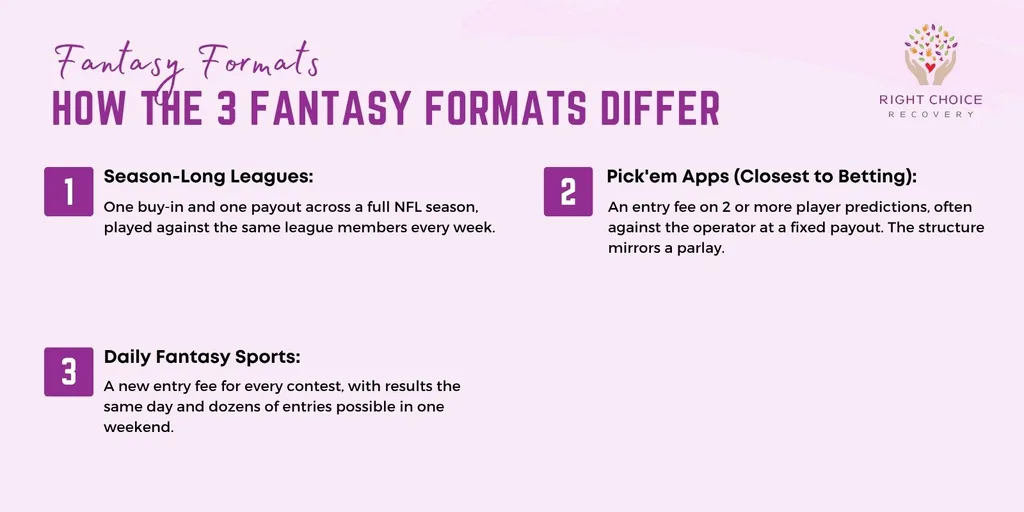
Season-long fantasy, daily fantasy and pick'em apps differ in how fast results arrive and in whether a player competes against other people or against the operator. Faster results and house-banked contests bring each format closer to sports betting.
The table below compares the 3 fantasy football formats on the features that matter most for gambling risk.
| Format | How the money works | Who the player competes against | How fast results arrive |
|---|---|---|---|
| Season-long fantasy league | One buy-in at the start of the season, one pot paid at the end | Other league members | Weekly matchups over about 4 months |
| Daily fantasy sports (DFS) | A new entry fee for each contest, often many contests a week | Other entrants in the contest | The same day or weekend |
| Pick'em app | An entry fee on 2 or more player predictions, paid at a set multiplier if all hit | Often the operator, at a fixed payout | When the games end, every day of the week |
Season-long fantasy leagues
Season-long fantasy leagues are the slowest fantasy football format, with one draft, one buy-in and one payout across a full NFL season. Players manage a roster week to week and compete against the same group of league members. The low pace keeps the money at stake fixed for most players.
Daily fantasy sports
Daily fantasy sports (DFS) contests let a player draft a new lineup under a salary cap and pay a new entry fee every day or weekend. Repeat entries are what raise the risk: a player can enter dozens of contests in one weekend and re-enter the next day after a loss.
Is PrizePicks gambling?
PrizePicks and similar pick'em apps work like gambling: a player pays to predict whether 2 or more athletes beat a stat line. The player wins a fixed multiple of the entry only if every pick is right. That structure mirrors a parlay, a single bet that combines several outcomes.
Pick'em apps sit closest to sports betting of the 3 fantasy formats. Many pick'em contests are played against the operator at a set payout rather than against other players, which is how a sportsbook works.
Each fantasy format sits differently under federal and New Jersey law.
Is gambling on fantasy football legal in New Jersey?
Paid fantasy football is legal in New Jersey for players 18 and older when the contest is run by an operator holding a permit from the Division of Consumer Affairs. The state's Fantasy Sports Act, P.L.2017, chapter 231, codified at N.J.S.A. 5:20-1 and following sections, was signed in August 2017.
New Jersey's law defines a fantasy sports activity as a paid contest in which a player manages an imaginary team and the outcome reflects relative skill. A result cannot rest solely on one athlete's performance or on a real team's score. The Division of Consumer Affairs adopted its fantasy sports rules in December 2019.
New Jersey's fantasy sports law does not name pick'em games.
In October 2023, the then-director of the New Jersey Division of Gaming Enforcement told an industry conference that pick'em contests resembling parlays are sports wagering in the state, according to the trade publication Covers. The director also said no operator offered them in New Jersey at that time.
Pick'em formats change often, and the Division of Consumer Affairs lists the fantasy operators currently permitted in the state.
The New Jersey Attorney General's 2023 warning about illegal betting and fantasy sites urges residents to use only state-authorized operators.
What does federal law say about fantasy sports?
Federal law excludes qualifying fantasy contests from the definition of a bet under the Unlawful Internet Gambling Enforcement Act of 2006 (UIGEA). Under 31 U.S.C. § 5362(1)(E)(ix), a contest qualifies only when no fantasy team mirrors a real team's roster and the contest meets 3 conditions:
- Fixed prizes: the prizes are set and disclosed in advance and do not depend on the number of players or the fees paid.
- Skill and multiple events: winning outcomes reflect the players' knowledge and skill and depend mainly on the statistics of individual athletes across several real games.
- No single result: no winning outcome rests on the score, point spread or performance of any real team or combination of teams, or solely on one athlete's single performance.
Many online summaries say the UIGEA declares fantasy sports a game of skill. The statute does not say that: it only excludes contests meeting these 3 conditions from its definition of a bet. The exclusion governs payment processing, does not legalize fantasy sports, and leaves each state to decide what is allowed.
Which states have restricted pick'em apps?
At least 4 states have acted against pick'em fantasy contests since 2023, treating them as sports betting. The following are the 4 best-documented actions:
- New York: the State Gaming Commission barred fantasy contests that mimic proposition bets in October 2023.
- Michigan: the Michigan Gaming Control Board's fantasy rules banning prop-style contests took effect in October 2023.
- Florida: the Florida Gaming Control Commission sent cease-and-desist letters to 3 pick'em operators in September 2023, according to trade press reports.
- California: the Attorney General issued a non-binding opinion in July 2025 that daily fantasy contests, including pick'em, are illegal sports betting in the state.
Gambling rules change quickly, and gambling laws in New Jersey cover casinos, sports wagering and online play under separate licenses.
A legal fantasy contest still carries gambling risk, and research on fantasy players has measured it.
Why can fantasy football turn into a gambling problem?
Fantasy football turns into a gambling problem when paid contests become frequent, fast and tied to chasing losses or big wins. Research from New Jersey and national surveys shows fantasy players carry more gambling problems than other gamblers.
The 2023 Rutgers survey of 3,512 New Jersey adults found that 66.4% of high-risk problem gamblers played daily fantasy sports and 67.6% played season-long fantasy. Among gamblers with no gambling problem, the figures were 4.7% and 8.8%.
High-risk problem gamblers in that survey played almost every form of gambling at high rates, so fantasy is one part of a wider pattern.
The National Council on Problem Gambling's 2025 national survey of more than 3,000 adults found that 24% of people who bet on fantasy sports reported problematic gambling behaviors, compared with 17% of traditional sports bettors.
Nower, Caler, Pickering and Blaszczynski (2018), writing in the Journal of Gambling Studies, compared 299 daily fantasy players with 1,847 other New Jersey gamblers. Daily fantasy players had more severe gambling problems and more co-occurring mental health problems, including suicidal thoughts. Anyone having thoughts of suicide can call or text 988, the Suicide and Crisis Lifeline, or chat at 988lifeline.org.
Edson and colleagues (2021) studied 34,596 daily fantasy subscribers and more than 18 million entries in Psychology of Addictive Behaviors. Players who landed a big win went on to pay higher entry fees, enter more contests and lose more money overall.
A 2016 PBS Frontline report, "Addicted to a Fantasy?", profiled a man in recovery who lost close to $20,000 on daily fantasy sports. He said fantasy sports advertising was the only thing that still triggered his urges to gamble.
These risk patterns show up as specific warning signs in a fantasy player's behavior.
What are the warning signs of a fantasy football gambling problem?
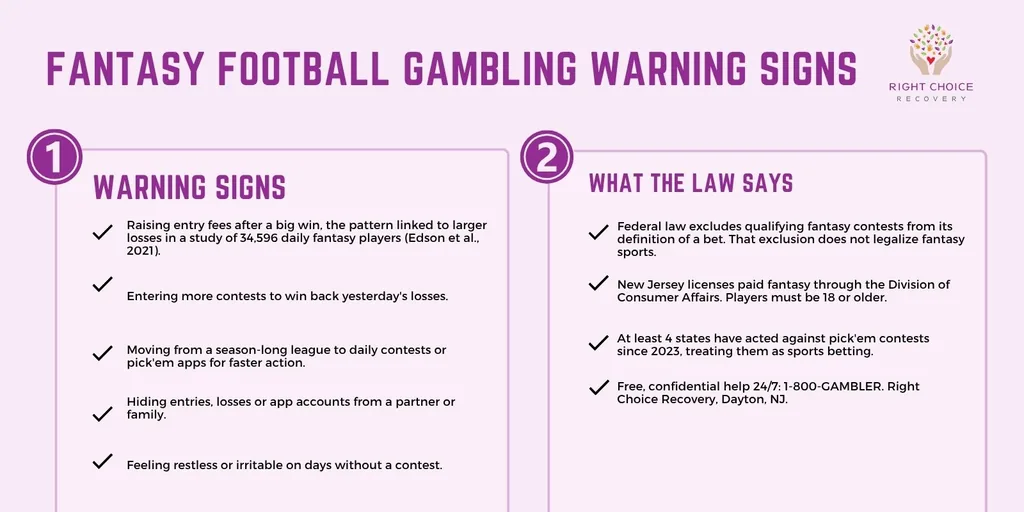
The main warning signs of a fantasy football gambling problem are rising entries, chasing losses, hiding play and feeling restless without it. These signs mirror the DSM-5-TR criteria for gambling disorder, applied to fantasy contests.
The following are the 7 warning signs that fantasy football has become a gambling problem:
- Raising entry fees after a big win, the pattern Edson and colleagues (2021) linked to larger losses.
- Entering more contests to win back yesterday's losses.
- Moving from a season-long league to daily contests or pick'em apps for faster action.
- Hiding entries, losses or app accounts from a partner or family.
- Checking scores and stats constantly during work, school or family time.
- Feeling restless or irritable on days without a contest.
- Borrowing money or using credit to fund entries.
Entering more contests to recover losses is chasing losses, one of the 9 DSM-5-TR criteria for gambling disorder and the sign Rob Sackowitz warns NFL fans about.
"A few years ago a fan could bet on a team or a parlay. Now there are player props, live bets and fantasy contests every night of the week, and one evening can cost more than a whole season-long league. When someone is entering contests on games they would never watch, just to have action, that is the red flag to stop and get help."
Rob Sackowitz, CEO and founder of Right Choice Recovery
A fantasy sports gambling problem responds to the same treatment as any other gambling disorder.
How does Right Choice Recovery help people who can't stop playing fantasy sports?
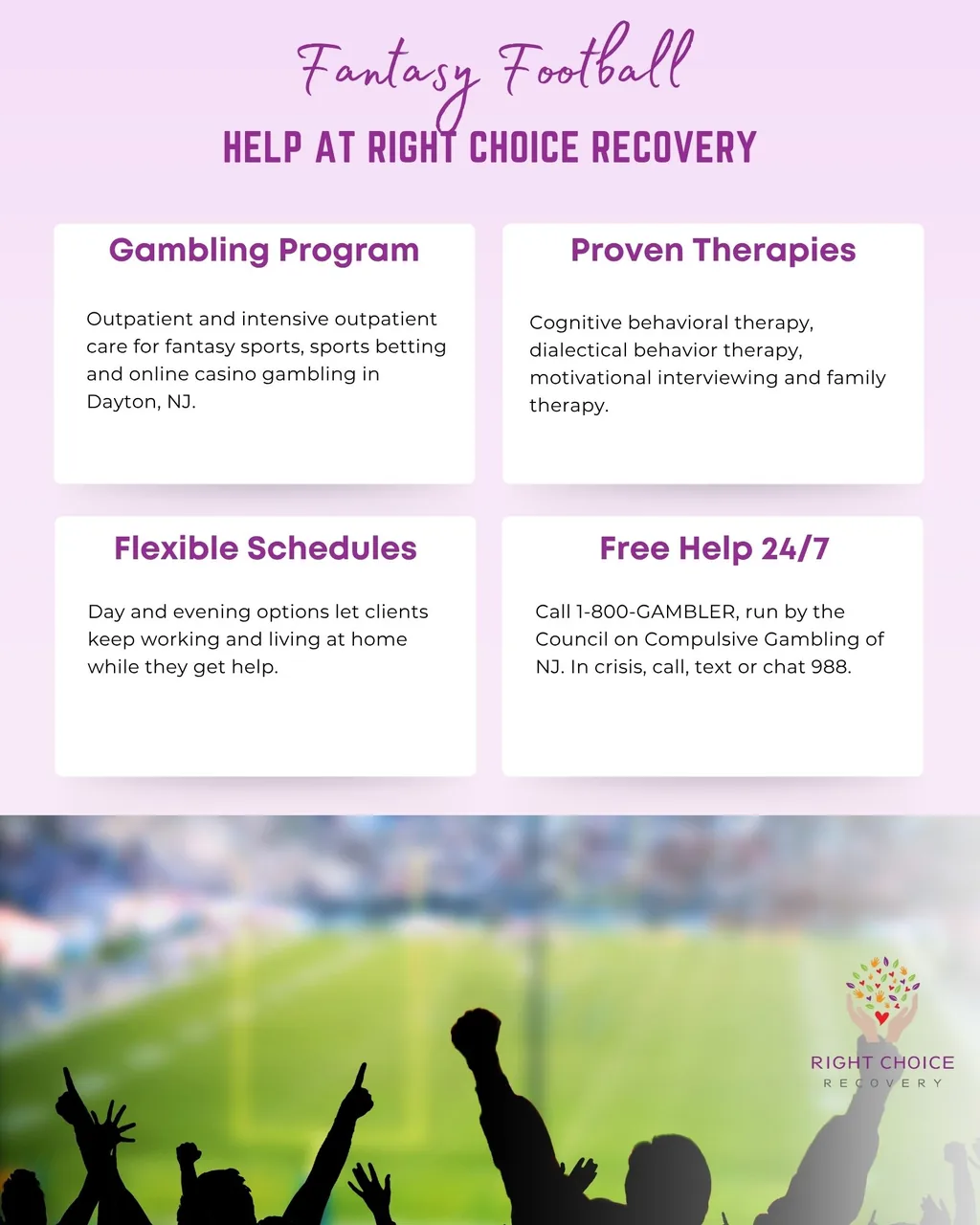
Right Choice Recovery helps people who can't stop playing fantasy sports through a compulsive gambling program at the outpatient and intensive outpatient levels in Dayton, New Jersey. Fantasy sports, sports betting and online casino gambling are treated in the same program, because the DSM-5-TR criteria apply to every form of gambling.
The compulsive gambling treatment program uses cognitive behavioral therapy (CBT), dialectical behavior therapy (DBT), motivational interviewing and family therapy, built on 12-step recovery principles. Evening and daytime options let clients keep working, and Right Choice Recovery also runs a gambling program for adolescents.
Right Choice Recovery partners with the Council on Compulsive Gambling of New Jersey, which runs 1-800-GAMBLER, a free and confidential helpline open 24 hours a day.
A confidential admissions assessment at Right Choice Recovery is the first step for anyone whose fantasy play has become a problem.
Frequently Asked Questions
Can someone get addicted to fantasy football?
Someone can get addicted to paid fantasy football, because it involves staking money on uncertain outcomes, the core of gambling disorder. Daily fantasy players in a New Jersey study by Nower and colleagues (2018) had more severe gambling problems than other gamblers.
Does fantasy football involve money?
Fantasy football involves money only when a league or contest charges an entry fee and pays a prize. Season-long leagues can be free or carry a buy-in, while daily fantasy contests and pick'em apps charge an entry fee for every contest. The money is what turns a fantasy game into gambling.
Is ESPN fantasy football gambling?
A free fantasy football league on a major sports platform such as ESPN is not gambling when no entry fee or prize is involved. The same league becomes gambling when members add a cash buy-in or side bets paid to the winner, even if the platform itself charges nothing.
Should someone in gambling recovery play fantasy football?
Someone in gambling recovery should avoid paid fantasy football, because entry fees and prizes make it gambling. A free league with no buy-in carries less risk, though it can still bring back the urge to bet.
How old do players have to be for paid fantasy sports in New Jersey?
Players must be 18 or older to enter paid fantasy sports contests in New Jersey. The Division of Consumer Affairs requires permitted operators to keep minors out of paid contests, under rules adopted in December 2019.
Does fantasy football count toward a gambling disorder diagnosis?
Fantasy football counts toward a gambling disorder diagnosis when it causes problems that meet the DSM-5-TR criteria. A clinician looks at the behavior, such as chasing losses or lying about play, rather than whether the law calls the contest skill or chance.
Are young men more at risk from fantasy sports?
Men, and young men in college, show higher risk from fantasy sports than other groups. Male gender predicted daily fantasy play in New Jersey (Nower et al., 2018), and among college students, men who paid to play fantasy sports had higher odds of gambling problems (Martin and Nelson, 2014).
Can players self-exclude from daily fantasy sites?
Players can self-exclude from daily fantasy sites, a tool that blocks a player's own account from entering contests. A 2022 study of daily fantasy subscribers by Nelson and colleagues found that fewer than 0.5% self-excluded, and nearly one-third of those did so more than once.
References
- American Psychiatric Association. (2022). Diagnostic and statistical manual of mental disorders (5th ed., text rev.). American Psychiatric Publishing.
- Edson, T. C., Tom, M. A., Philander, K. S., Louderback, E. R., & LaPlante, D. A. (2021). A large-scale prospective study of big wins and their relationship with future financial and time involvement in actual daily fantasy sports contests. Psychology of Addictive Behaviors, 35(8), 948-960.
- Martin, R. J., & Nelson, S. (2014). Fantasy sports, real money: Exploration of the relationship between fantasy sports participation and gambling-related problems. Addictive Behaviors, 39(10).
- National Council on Problem Gambling. (2025, July 17). National Council on Problem Gambling survey shows drop in problem gambling risk, highlights ongoing challenges (NGAGE 3.0 survey release).
- Nelson, S. E., Edson, T. C., Grossman, A., et al. (2022). Time out: Prediction of self-exclusion from daily fantasy sports. Psychology of Addictive Behaviors.
- New Jersey Office of the Attorney General. (2023, September 1). With kickoff to pro and college football seasons here, New Jerseyans urged to avoid illegal online sports betting and fantasy sports sites.
- Nower, L., Caler, K. R., Pickering, D., & Blaszczynski, A. (2018). Daily fantasy sports players: Gambling, addiction, and mental health problems. Journal of Gambling Studies, 34(3), 727-737.
- Nower, L., Stanmyre, J. F., & Anthony, V. (2023). The prevalence of online and land-based gambling in New Jersey. Report to the New Jersey Division of Gaming Enforcement. Rutgers Center for Gambling Studies.
- Taddonio, P. (2016, February 9). Addicted to a fantasy? FRONTLINE, PBS.
- Unlawful Internet Gambling Enforcement Act of 2006, 31 U.S.C. § 5362(1)(E)(ix).
- New Jersey Fantasy Sports Act, P.L.2017, c.231, N.J.S.A. 5:20-1 et seq.
Share This Post