
Cocaine Detox Timeline: What to Expect

Cocaine detox is the period during which cocaine leaves the body and withdrawal symptoms rise and settle. It begins within hours of the last use.
Most acute symptoms resolve within one to two weeks. Low mood and intermittent cravings persist for weeks or months after that.
Cocaine withdrawal differs from alcohol and benzodiazepine withdrawal in one important respect. The hardest symptoms are psychological rather than physical, which makes the process less medically dangerous but no easier to get through alone.
The sections below set out what happens at each stage of the cocaine detox timeline, how long each stage lasts, and what shortens or extends it.
Key Takeaways
- Cocaine withdrawal follows a predictable sequence. The crash begins within hours and lasts 1 to 3 days, acute withdrawal peaks across 1 to 2 weeks, and protracted symptoms continue for up to 6 months.
- Psychological symptoms outlast and outweigh physical symptoms. Anhedonia, the loss of the ability to feel pleasure, is the symptom people report as hardest to tolerate.
- No FDA-approved medication treats cocaine withdrawal or cocaine use disorder, according to the National Institute on Drug Abuse. Clinicians treat individual symptoms and rely on behavioral therapy for the disorder itself.
- Cocaine withdrawal rarely threatens life physically, but it produces severe depression and suicidal thoughts during the crash. Anyone experiencing these thoughts can reach the 988 Suicide and Crisis Lifeline by call or text at any hour.
Did you know most health insurance plans cover substance use disorder treatment? Check your coverage online now.
What Is Cocaine Detox?
Cocaine detox is the process of clearing cocaine and its metabolites from the body while the withdrawal symptoms that follow are managed. Detox stabilizes a person over days to two weeks. It does not treat cocaine use disorder, which requires months of behavioral treatment.
That distinction matters because people frequently complete detox and stop there. Detox resolves the physical presence of the drug, while the compulsive use pattern that defines cocaine use disorder persists well past the point where symptoms fade.
Cocaine has a half-life of roughly one hour, which is why withdrawal begins so quickly. The liver converts cocaine into benzoylecgonine, a metabolite that remains detectable long after the drug itself has cleared.
Route of administration changes how fast the crash arrives. Smoking crack cocaine or injecting cocaine produces a faster onset and a sharper early crash than intranasal use, because both deliver the drug to the brain within seconds.
How Long Does Cocaine Withdrawal Last?
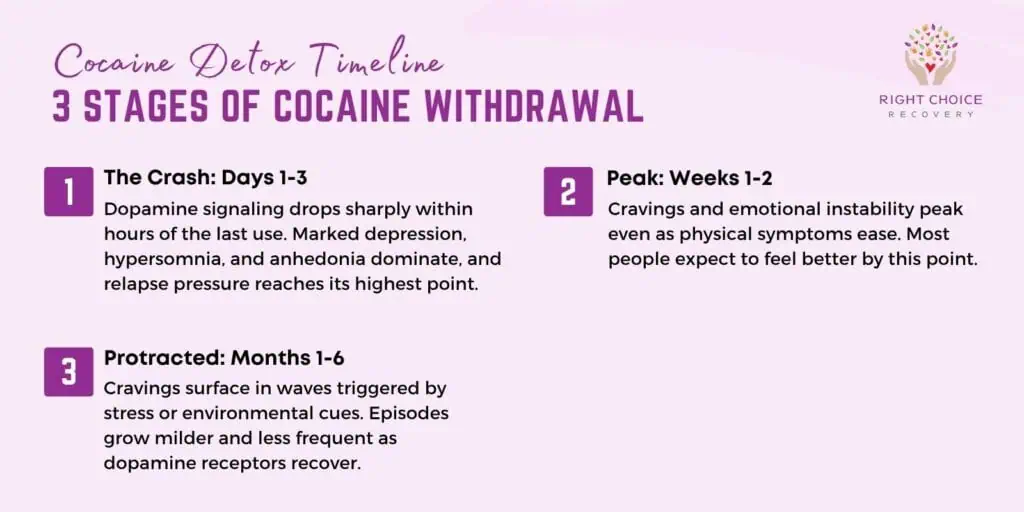
Cocaine withdrawal moves through six stages spanning the first hour after the last use to roughly six months. Acute symptoms resolve within 1 to 2 weeks. Protracted symptoms continue intermittently for up to 6 months.
Frank Gawin and Herbert Kleber described the underlying pattern in Archives of General Psychiatry in 1986, dividing cocaine abstinence into three phases they named the crash, withdrawal, and extinction. Later inpatient studies, including Weddington and colleagues in 1990, recorded a smoother decline than the original outpatient observations suggested.
| Stage | Time period | What happens |
|---|---|---|
| Crash begins | 0 to 24 hours | Exhaustion, flat mood, early cravings |
| Acute crash | Days 1 to 3 | Marked depression, hypersomnia, anhedonia |
| Early withdrawal | Days 4 to 7 | Mood swings, poor concentration, vivid dreams |
| Peak withdrawal | Weeks 1 to 2 | Strongest cravings, greatest emotional instability |
| Gradual improvement | Weeks 2 to 4 | Lingering cognitive symptoms, elevated relapse risk |
| Protracted withdrawal | Months 1 to 6 | Intermittent cravings, fluctuating mood |
Each stage carries a distinct symptom profile.
- 0 to 24 hours. Dopamine signaling drops sharply as the drug clears. Profound exhaustion, a flattened mood, and early cravings emerge within the first few hours.
- Days 1 to 3. The acute crash produces marked depression, hypersomnia or insomnia, and anhedonia. Relapse pressure reaches its highest point because using again relieves the crash immediately.
- Days 4 to 7. Mood swings and impaired concentration dominate. Vivid dreams and disrupted sleep recur as sleep architecture recalibrates.
- Weeks 1 to 2. Cravings and emotional instability peak even as physical symptoms ease. Most people expect to feel better by this point and are caught off guard.
- Weeks 2 to 4. Energy and sleep improve while cognitive symptoms persist. Slowed thinking and memory lapses interfere with work and relationships.
- Months 1 to 6. Protracted withdrawal produces cravings that surface in waves, triggered by stress or environmental cues. Episodes grow milder and less frequent over time.
Stage five carries disproportionate relapse risk. Visible improvement in sleep and energy convinces people the process has finished, while the underlying dopamine deficit that drives craving has not yet resolved. General drug withdrawal patterns follow a similar shape across substance classes.
What Are the Symptoms of Cocaine Withdrawal?
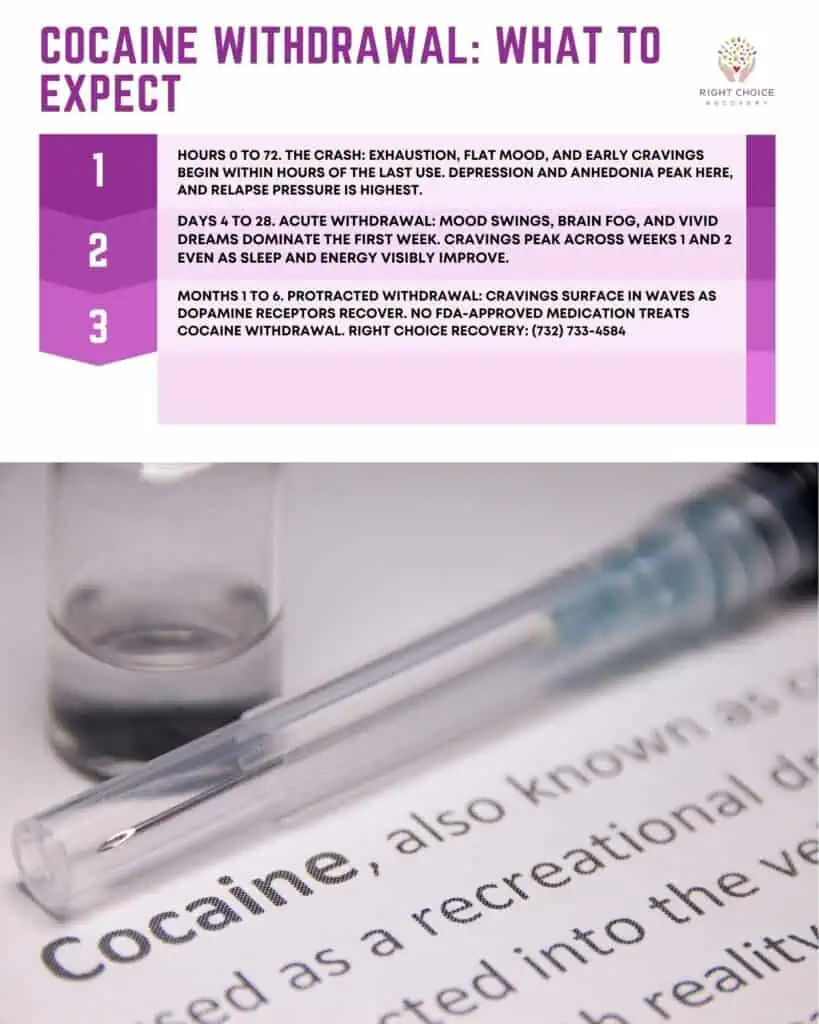
Cocaine withdrawal produces psychological symptoms that are more severe and longer-lasting than its physical symptoms. This asymmetry distinguishes stimulant withdrawal from alcohol and opioid withdrawal, where physical symptoms dominate the acute phase.
Psychological Symptoms of Cocaine Withdrawal
Cocaine withdrawal produces seven core psychological symptoms:
- Anhedonia removes the ability to take pleasure in food, sex, exercise, and social contact. People describe the state as feeling flat.
- Depression deepens through the first three days and lifts gradually over the following weeks.
- Intense cravings arrive in waves rather than as constant pressure. Each wave typically peaks and subsides within 15 to 30 minutes.
- Anxiety and agitation replace the stimulant arousal the brain has adapted to expect.
- Irritability strains relationships during exactly the period when support matters most.
- Impaired concentration produces what people call brain fog, which persists into weeks three and four.
- Paranoid thinking occurs in some people during early abstinence and resolves as dopamine signaling stabilizes.
Physical Symptoms of Cocaine Withdrawal
Cocaine withdrawal produces six common physical symptoms:
- Fatigue exceeds ordinary tiredness and persists through the first one to two weeks.
- Hypersomnia follows the crash, with some people sleeping 12 hours or more at a stretch.
- Increased appetite rebounds sharply once the appetite suppression of cocaine lifts.
- Muscle aches and headaches produce a generalized flu-like discomfort.
- Night sweats accompany the sleep disruption of days four through fourteen.
- Slowed movement and psychomotor retardation appear in the DSM-5-TR criteria for cocaine withdrawal.
These physical symptoms are milder than those of alcohol or benzodiazepine withdrawal. That mildness makes cocaine withdrawal deceptive, because people judge severity by physical discomfort and underestimate the psychological load.
Contact us today to schedule an initial assessment or to learn more about our services. Whether you are seeking intensive outpatient care or simply need guidance on your mental health journey, we are here to help.
How Is Cocaine Withdrawal Severity Measured?
Clinicians measure cocaine withdrawal severity with the Cocaine Selective Severity Assessment (CSSA). The CSSA is an 18-item clinician-administered scale developed by Kampman and colleagues in 1998, and it takes under 10 minutes to complete.
The CSSA rates depression, fatigue, anhedonia, anxiety, irritability, sleep disturbance, concentration, paranoia, carbohydrate craving, bradycardia, and suicidality. Most items score from 0 to 7, with higher totals indicating more severe withdrawal.
Higher CSSA scores predict poorer treatment retention and greater relapse risk. Severity scoring shapes the level of care a person needs, which depends in turn on the degree of physical and psychological dependence present at intake.
What Factors Change the Cocaine Detox Timeline?
Seven variables determine where within these ranges a person’s timeline falls. Two people with similar use patterns routinely experience withdrawal of different length and intensity.
The following factors extend or compress the cocaine detox timeline:
- Duration of use determines how far dopamine receptor availability has downregulated. Years of daily use produce longer protracted withdrawal than several weeks of use. Long-term cocaine use also damages cardiac and cognitive function independently.
- Daily quantity drives the depth of the neurological adaptation, and heavier daily amounts produce a steeper crash.
- Route of administration changes onset speed. Smoking and injection deliver cocaine to the brain within seconds and produce faster, more chaotic early withdrawal than intranasal use.
- Co-occurring psychiatric conditions intensify withdrawal because depression and anxiety compound the symptoms cocaine withdrawal already produces.
- Polysubstance use complicates the picture. Concurrent alcohol or benzodiazepine dependence introduces seizure risk that cocaine alone does not carry.
- Cardiovascular health determines how closely the process needs monitoring, since existing heart disease raises the risk of complications during the acute phase.
- Prior detox attempts shorten the interval before cravings return, a pattern that reflects conditioned cue sensitivity rather than personal failure.
Why Does Cocaine Withdrawal Happen?
Cocaine withdrawal happens because chronic cocaine exposure downregulates the brain’s dopamine system, which cannot resume normal function the moment the drug is removed. The resulting dopamine deficit produces the anhedonia, fatigue, and craving that define withdrawal.
The process follows five steps. Cocaine blocks the dopamine transporter, which prevents dopamine from being cleared out of the synapse. Synaptic dopamine accumulates far above natural levels.
The brain responds by reducing dopamine receptor density in the nucleus accumbens and the ventral tegmental area. Removing cocaine then leaves a system with too few receptors and too little dopamine to stimulate them.
Receptor availability recovers over weeks to months, not days. That recovery interval is the neurobiological reason protracted withdrawal exists, and it explains why the brain reward system continues generating cravings long after the drug has cleared.
What Makes Cocaine Withdrawal Dangerous?
Cocaine withdrawal rarely produces the life-threatening physical complications of alcohol or benzodiazepine withdrawal. Its danger is psychiatric rather than physical, and severe depression during the crash phase is the central risk.
Alcohol and benzodiazepine withdrawal can produce seizures and delirium tremens, which is why both require a medically supervised taper. Cocaine withdrawal produces neither. Assuming all withdrawal carries the same physical danger leads people to misjudge which risks actually apply.
Four risks warrant clinical attention during cocaine withdrawal:
- Severe depression and suicidal thoughts concentrate in the first 72 hours. The Cocaine Selective Severity Assessment includes suicidality as a scored item precisely because the risk is well documented.
- Cardiovascular strain matters for anyone with existing heart disease, since cocaine damages cardiac tissue and the acute phase places additional demand on a compromised system.
- Overdose after relapse follows reduced tolerance. Returning to a previous dose after a period of abstinence carries higher risk than the same dose during active use, as documented in NIDA cocaine research.
- Untreated co-occurring conditions surface once cocaine stops masking them. Depression and anxiety disorders that predate the substance use become visible and require their own treatment.
Anyone experiencing thoughts of suicide can reach the 988 Suicide and Crisis Lifeline by calling or texting 988, 24 hours a day. Support is available in English and Spanish.
How Is Cocaine Withdrawal Treated?
No FDA-approved medication treats cocaine withdrawal or cocaine use disorder. Treatment combines symptom-targeted medication with behavioral therapy, and the behavioral component carries the stronger evidence base.
Prescribers address individual symptoms rather than the withdrawal syndrome as a whole. Non-addictive sleep medication addresses insomnia, and antidepressants are used where depression persists past the acute phase rather than during it.
Four behavioral approaches carry evidence for stimulant use disorder:
- Contingency management holds the strongest evidence base of any intervention for stimulant use disorder. The American Society of Addiction Medicine and the American Academy of Addiction Psychiatry named it a primary recommendation in their 2023 clinical practice guideline.
- Cognitive Behavioral Therapy identifies the thought patterns preceding use and replaces them with rehearsed alternatives.
- The Matrix Model combines relapse prevention, family education, and urine testing across a structure built specifically for stimulant users.
- Community Reinforcement Approach restructures daily activity so that non-drug rewards become accessible while anhedonia resolves.
Detox alone does not treat cocaine use disorder. The Substance Abuse and Mental Health Services Administration identifies continued treatment after withdrawal as the factor that separates sustained recovery from repeated detox cycles.
Rediscover Life at {mb_website-settings_var_company_name}
Get the compassionate health support you deserve. We're here to help you reclaim joy, wellness, and a brighter future.
Our Facility
How Does Right Choice Recovery Support Cocaine Recovery?
Right Choice Recovery does not provide medical detox on site. The facility coordinates detox with partner providers in New Jersey, then delivers the outpatient treatment that follows without a second assessment delay.
That sequencing addresses the weeks two through four window specifically. Relapse risk stays elevated exactly when energy and sleep have visibly improved, and structured daily contact during that window is what outpatient programming provides.
“The people we see relapse are rarely the ones who felt terrible at week one. They are the ones who felt fine at week two and decided they were finished.” Caitlin Moore, LPC, LCADC, CCS, ICGC-1, Clinical Director, Right Choice Recovery
Partial Care runs Monday through Thursday from 9:00 AM to 2:00 PM and Friday from 9:00 AM to 12:00 PM. The intensive outpatient program adds an evening track meeting Monday through Thursday from 6:00 PM to 9:00 PM for people holding jobs.
Free same-day intake assessments include a level-of-care recommendation. Cocaine addiction treatment at the Dayton, New Jersey center covers Partial Care, intensive outpatient, and standard outpatient levels.
Frequently Asked Questions
How long does cocaine stay in the body?
Cocaine itself clears within hours, but its metabolite benzoylecgonine remains detectable far longer. Urine testing detects it for 2 to 4 days after occasional use and up to a week after heavy use. Detection windows are separate from withdrawal duration, which continues well past the point where testing turns negative.
Can a person detox from cocaine at home?
Home detox is physically possible because cocaine withdrawal does not produce seizures, so the obstacle is psychological rather than medical. Continued access to cocaine during the crash, when relapse pressure peaks, is what causes most home attempts to fail. A structured setting removes that access.
Does crack withdrawal differ from powder cocaine withdrawal?
The stages are the same, but crack produces faster onset and sharper early cravings. Smoking delivers cocaine to the brain within seconds, creating rapid binge and crash cycles that intensify the first days of withdrawal. Total duration is comparable across both routes.
Are you covered for treatment?


{mb_website-settings_var_company_name} is an approved provider for Blue Cross Blue Shield and Cigna, while also accepting many other major insurance carriers.
Check Coverage Now!Can cocaine withdrawal cause seizures?
Cocaine withdrawal does not cause seizures. Seizures are associated with cocaine intoxication and overdose rather than with stopping, and the confusion arises because alcohol and benzodiazepine withdrawal do produce them. Anyone dependent on those substances alongside cocaine requires medically supervised withdrawal.
Does exercise help with cocaine withdrawal?
Moderate exercise supports recovery during withdrawal by raising dopamine and endorphin activity naturally. Walking, swimming, and cycling improve sleep quality and reduce craving intensity. Exercise does not shorten the timeline, and it works as a complement to treatment rather than a replacement for it.
What should a person tell family before starting detox?
Telling at least one trusted person is the single most useful preparation step. Practical arrangements matter: work coverage, childcare, and transport. Family members who understand the weeks two through four risk window are better positioned to notice disengagement before it becomes relapse.
How soon after detox can outpatient treatment begin?
Outpatient treatment can begin immediately after detox completes, and starting without a gap produces better retention. The interval between finishing detox and entering treatment is when most people disengage. Facilities that coordinate both stages remove the assessment delay that creates that gap.
Is cocaine withdrawal the same for everyone?
The stages are consistent but their length and intensity vary widely. Duration of use, daily amount, route, co-occurring conditions, and prior attempts all shift the timeline. A person expecting an exact schedule will find their own experience differs, which is normal rather than a sign of complication.
Did you know most health insurance plans cover substance use disorder treatment? Check your coverage online now.
References
- American Psychiatric Association. (2022). Diagnostic and statistical manual of mental disorders (5th ed., text rev.). American Psychiatric Publishing.
- American Society of Addiction Medicine & American Academy of Addiction Psychiatry. (2023). Clinical practice guideline on the management of stimulant use disorder.
- Gawin, F. H., & Kleber, H. D. (1986). Abstinence symptomatology and psychiatric diagnosis in cocaine abusers: Clinical observations. Archives of General Psychiatry, 43(2), 107–113.
- Kampman, K. M., Volpicelli, J. R., McGinnis, D. E., Alterman, A. I., Weinrieb, R. M., D’Angelo, L., & Epperson, L. E. (1998). Reliability and validity of the Cocaine Selective Severity Assessment. Addictive Behaviors, 23(4), 449–461.
- National Institute on Drug Abuse. (2024). Cocaine research report. National Institutes of Health.
- New Jersey Department of Health. (2026). New Jersey overdose data dashboard. Office of Population Health.
- Substance Abuse and Mental Health Services Administration. (2024). Contingency management advisory (PEP24-06-001).
- Weddington, W. W., Brown, B. S., Haertzen, C. A., Cone, E. J., Dax, E. M., Herning, R. I., & Michaelson, B. S. (1990). Changes in mood, craving, and sleep during short-term abstinence reported by male cocaine addicts. Archives of General Psychiatry, 47(9), 861–868.
Medically reviewed by Caitlin Moore, LPC, LCADC, CCS, ICGC-1, Clinical Director at Right Choice Recovery. Last reviewed .
Share This Post
